Have you ever noticed a small glass and fork symbol printed on the bottom of a food container, lunch box, plate, cup, or kitchen product and wondered what it actually means?
You are not alone. The symbol can look like an ordinary logo at first glance, but it has a practical purpose. It is generally used to indicate that a material is intended to come into contact with food.
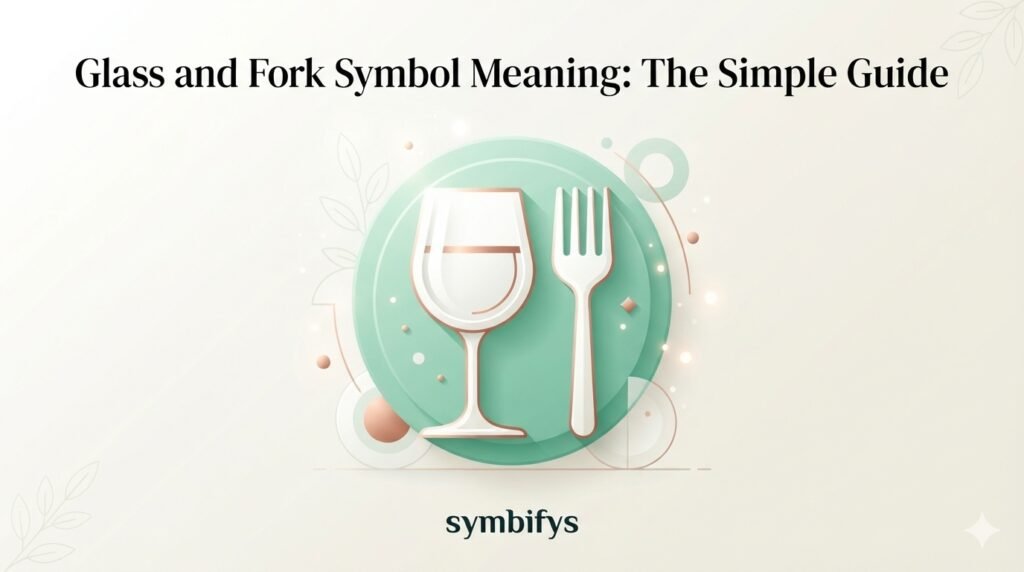
The symbol is often shown as a wine-glass and fork, usually together inside a square or other simple shape. You may find it on plastic containers, reusable food-storage products, packaging, cookware, and other items associated with eating or drinking.
People commonly search for “what does glass and fork symbol mean” because manufacturers use many different symbols on everyday products. Recycling symbols, dishwasher symbols, microwave symbols, and food-contact symbols can look confusing when you see several of them together.
Understanding this particular mark helps you distinguish between a product being designed for food contact and a product that simply happens to look suitable for storing or serving food.
What Does Glass and Fork Symbol Mean? – Quick Meaning
The glass and fork symbol is commonly recognized as the food-contact symbol.
In simple terms, it tells you that the item or material is intended for contact with food under appropriate conditions.
You may see it represented as:
- A wine glass and fork side by side
- A wine glass and fork inside a square
- The words “for food contact”
- A similar food-contact indication printed directly on packaging
For example:
“This container has the glass and fork symbol, so it is designed for food contact.”
Another everyday example is:
“Look underneath the lunch box. The glass and fork mark indicates its intended food-contact use.”
Or:
“The symbol doesn’t automatically mean the container is microwave-safe.”
That last point is important. Food-contact suitability and microwave suitability are not the same thing. A product can be intended for food contact while having separate restrictions concerning heat, freezing, cleaning, or particular foods.
Origin & Background of the Glass and Fork Symbol
The glass-and-fork mark developed from the need to communicate food-contact suitability clearly and simply, particularly across products, languages, and international markets.
Instead of relying entirely on words, manufacturers can use a recognizable pictogram. This is especially useful because food packaging and household products are sold across countries where consumers speak different languages.
The symbol is associated with European food-contact labeling practices and is particularly familiar on products sold within or for the European market. European food-contact rules establish requirements intended to prevent materials that come into contact with food from transferring substances into food at levels that could create safety concerns or otherwise affect food improperly.
Over time, the symbol became familiar far beyond formal regulatory discussions.
You might see it on a plastic storage box purchased online, a reusable bottle, a kitchen utensil, or food packaging. As international shopping expanded, consumers began encountering symbols from different regulatory systems on the same products.
Social media has also contributed to the confusion.
A photograph of the symbol can quickly circulate on Instagram, TikTok, Facebook, or messaging apps, often accompanied by claims such as “this symbol means the plastic is safe” or “this means it can go in the microwave.”
Those claims can be misleading.
The glass and fork symbol has a specific purpose, and it should not automatically be interpreted as a universal guarantee covering every possible use.
Real-Life Conversations
Person A:
“What does this glass and fork symbol mean on my new food container?”
Person B:
“It usually means the material is intended for food contact.”
Person A:
“So I can put hot food in it?”
Person B:
“Not necessarily. Check whether the container has separate temperature or heating instructions.”
Instagram DM
Person A:
“I found this symbol underneath my bottle. Is it a recycling symbol?”
Person B:
“No, the little fork and glass symbol is usually related to food contact.”
Person A:
“Oh! I thought every symbol underneath plastic meant recycling.”
Person B:
“Easy mistake. Look for the recycling triangle separately.”
TikTok Comments
Person A:
“What does the glass and fork thing on plastic mean?”
Person B:
“It indicates the item is intended for food contact.”
Person A:
“Does that mean microwave-safe?”
Person B:
“Nope. Microwave-safe is a different claim. Check the microwave symbol or the manufacturer’s instructions.”
Text Messages
Person A:
“Can I use this container for leftovers?”
Person B:
“Does it have the food-contact symbol?”
Person A:
“Yeah, the glass and fork.”
Person B:
“That indicates it’s intended for food contact. Just check the product instructions for heat and storage limits.”
Emotional & Psychological Meaning
Unlike many symbols discussed online, the glass and fork symbol usually does not express an emotion, personality, or hidden social message.
It is a practical communication symbol.
Its purpose is reassurance and clarity. When you see it, the manufacturer is communicating something about the intended relationship between the material and food.
This is an interesting part of modern communication: not every symbol is designed to express feelings.
Some symbols exist simply because words are inconvenient.
Imagine opening a new lunch container while preparing breakfast. You turn it over and notice a tiny fork and wine glass. You don’t want to search through a manual just to understand every mark on the bottom, so the pictogram gives you an immediate clue.
That tiny image is doing something words often struggle to do efficiently: communicating across language barriers in a fraction of a second.
In my experience, the biggest source of confusion comes from treating every symbol as if it provides a complete safety certificate. It doesn’t. A symbol communicates one piece of information, while the product’s instructions may provide the rest.
Usage in Different Contexts
Social Media
On social media, people often share photographs of unfamiliar symbols found on bottles, containers, cookware, and packaging.
Someone might post:
“Can anyone tell me what this symbol means?”
The answer is usually practical rather than emotional or slang-related.
Be careful, however, when sharing advice online. A food-contact symbol should not be used as proof that a product is suitable for every food, temperature, appliance, or cleaning method.
Friends and Relationships
In casual conversations, someone may simply call it the “fork and glass symbol.”
For example:
“Check the bottom. It has that fork-and-glass symbol.”
This is perfectly understandable in everyday speech.
People don’t normally need the formal terminology unless they’re discussing product labeling, regulations, manufacturing, or safety.
Work and Professional Settings
In professional environments involving food packaging, manufacturing, hospitality, retail, or product compliance, precision matters more.
Instead of saying:
“The plastic is safe.”
A more accurate statement is:
“The product is indicated for food-contact use, subject to the applicable conditions and manufacturer instructions.”
That distinction prevents people from making broader claims than the symbol actually supports.
Casual vs. Serious Tone
In casual conversation, “glass and fork symbol” is usually enough.
In a serious context, describe it as a food-contact symbol and then consider the specific product instructions and applicable regulations.
When NOT to Use It
The glass-and-fork symbol itself is not something you normally “use” like slang. Rather, there are situations where you should not interpret it beyond what it communicates.
Don’t Treat It as a Microwave Symbol
Food-contact suitability does not automatically mean microwave suitability.
A container may be suitable for food contact but unsuitable for high temperatures.
Don’t Treat It as a Recycling Symbol
The symbol does not tell you what type of plastic the product contains or whether it belongs in a particular recycling stream.
Look for a separate recycling identification mark.
Don’t Assume Unlimited Safety
The mark does not necessarily mean the product can safely hold every type of food under every condition.
Temperature, duration, food composition, and intended use can matter.
Don’t Ignore Manufacturer Instructions
If a container says not to use it with boiling liquids, ovens, or certain appliances, follow those instructions even if a food-contact symbol is present.
Don’t Use the Symbol as a Social or Emotional Emoji
Someone showing you a glass-and-fork icon in a conversation isn’t automatically expressing a secret emotional meaning.
Context matters, especially online, where ordinary symbols can occasionally be repurposed as jokes or memes.
Common Misunderstandings
“It means microwave-safe.”
This is probably one of the most common mistakes.
A food-contact symbol indicates intended food contact; it does not automatically certify a product for microwave heating.
“It means the plastic is recyclable.”
Not necessarily.
Food-contact labeling and recycling identification serve different purposes.
“It means every food is safe in the container.”
That’s too broad.
Food-contact materials are designed and assessed according to applicable requirements and intended conditions of use.
“It means the product has no chemicals.”
That interpretation goes far beyond what the symbol communicates.
Food-contact materials can contain many different substances. The relevant question is whether they comply with applicable requirements for their intended use.
“The glass means the container is made of glass.”
No.
The glass image is part of a pictogram. It does not mean the product itself is manufactured from glass.
Comparison Table
| Symbol / Expression | Main Meaning | What It Does NOT Automatically Mean |
|---|---|---|
| Glass and fork symbol | Intended for food contact | Microwave-safe or dishwasher-safe |
| Recycling symbol | Indicates recycling-related information | Safe for food |
| Microwave symbol | Indicates microwave-related suitability | Suitable for every type of food |
| Dishwasher symbol | Indicates dishwasher-related suitability | Safe for extreme temperatures |
| Plastic resin code | Identifies a plastic material category | Food-contact approval |
| “Food safe” wording | Indicates intended food use | Unlimited use under all conditions |
| “BPA-free” | Refers to BPA content/claim | Automatically safe for every application |
| “For food contact” | Explicit food-contact indication | Permission for every temperature or food |
Key Insight
The easiest way to remember the difference is this: the glass-and-fork symbol answers the question “Is this material intended to come into contact with food?” It does not answer every question about how, where, or at what temperature you can use the product.
Variations and Types
The exact appearance can vary depending on the manufacturer, market, and labeling system.
1. Glass and Fork Pictogram
Meaning: Indicates intended food-contact use.
Explanation: This is the classic symbol most people mean when they ask about the glass and fork symbol.
2. Glass and Fork Inside a Square
Meaning: Food-contact indication displayed within a bordered area.
Explanation: The surrounding shape can vary without changing the basic purpose of the pictogram.
3. “For Food Contact” Text
Meaning: A written food-contact indication.
Explanation: Some products use words rather than relying only on the pictogram.
4. Food-Contact Label on Packaging
Meaning: The packaging or material is intended for food contact.
Explanation: You may see the indication on packaging rather than directly on the reusable item.
5. Food-Contact Documentation
Meaning: Formal information supporting a material’s intended food-contact use.
Explanation: In professional settings, documentation can be much more informative than a small symbol alone.
6. Microwave Symbol
Meaning: Indicates microwave-related suitability.
Explanation: This should be interpreted separately from the glass-and-fork mark.
7. Dishwasher Symbol
Meaning: Indicates dishwasher-related instructions.
Explanation: It answers a cleaning question, not the basic food-contact question.
8. Recycling Identification Symbol
Meaning: Provides information about material/recycling identification.
Explanation: It should not be confused with the food-contact pictogram.
9. Plastic Identification Code
Meaning: Identifies a particular plastic category.
Explanation: The code helps identify material type but does not by itself answer every question about food use.
10. Manufacturer Food-Use Instructions
Meaning: Provides specific information about intended conditions.
Explanation: These instructions can clarify temperature, storage, heating, freezing, or cleaning limitations.
How to Respond When Someone Uses It
Because the glass-and-fork symbol is usually informational rather than emotional slang, your response should depend on the conversation.
Casual Replies
- “That’s the food-contact symbol.”
- “It means the item is intended for food contact.”
- “Yep, that’s the little fork-and-glass mark.”
Funny Replies
- “Congratulations, your container speaks pictogram.”
- “The fork and glass are basically saying, ‘Food goes here.’”
- “Not a secret code—just a food-contact symbol!”
Mature Replies
- “It generally indicates that the material is intended for food contact, but I’d still check the manufacturer’s instructions for specific uses.”
- “It relates to food contact rather than microwave or dishwasher compatibility.”
Respectful Replies
- “It usually indicates that the product is intended for food contact.”
- “You can check the manufacturer’s instructions for any additional restrictions.”
Regional & Cultural Usage
Western Culture
In Europe and other Western markets, consumers may encounter the glass-and-fork pictogram on packaging and household products. European consumers are particularly likely to recognize it because of its association with European food-contact labeling.
In North America, people may be more accustomed to seeing written claims, recycling codes, or other product-specific markings, although food-contact information can appear in different forms.
Asian Culture
Across Asian markets, imported European products can carry the glass-and-fork symbol alongside local labeling.
Because many households use multilingual products and imported kitchenware, pictograms can be particularly useful. A simple visual mark can communicate basic product information without requiring consumers to understand the language printed elsewhere on the package.
Middle Eastern Culture
The symbol may appear on imported food packaging, kitchen products, and reusable containers.
However, food-contact suitability should not be confused with other concepts such as halal status. A glass-and-fork symbol concerns food contact; it does not certify that a product, ingredient, or manufacturing process is halal.
Global Internet Usage
Online, the symbol has become a common subject of quick “what does this mean?” questions.
People photograph the bottom of containers and ask strangers to identify the markings. This is useful, but online answers should avoid turning a simple symbol into an exaggerated safety claim.
Generational Differences: Gen Z vs. Millennials
Younger users may encounter unfamiliar symbols through online shopping, TikTok videos, and short-form educational content.
Millennials may be more accustomed to traditional product labels and instruction manuals.
Neither group has a special alternative meaning for the glass-and-fork symbol. The difference is mainly how people discover and discuss the information.
Is It Safe for Kids?
The glass-and-fork symbol itself is not a warning symbol. It generally indicates intended food-contact use.
However, parents should not interpret the symbol as meaning that every product is automatically safe for every situation involving children.
For example, check whether a bottle, lunch box, or cup is suitable for the intended temperature and type of use. Also consider choking hazards, breakable components, sharp edges, and age-specific product instructions.
For children’s products, the entire product design and its instructions matter—not just one symbol.
FAQs
1. What does the glass and fork symbol mean?
The glass-and-fork symbol generally indicates that a material or product is intended to come into contact with food under its intended conditions of use.
2. Does the glass and fork symbol mean microwave-safe?
No. Food-contact suitability does not automatically mean microwave-safe. Look for separate microwave instructions or a microwave symbol.
3. Does the glass and fork symbol mean BPA-free?
No. The symbol does not specifically indicate whether a product contains BPA.
4. Does the glass and fork symbol mean recyclable?
No. Recycling information is normally communicated through separate recycling symbols or material identification codes.
5. Can I put hot food in a container with this symbol?
Not automatically. Check the manufacturer’s temperature and heating instructions before using a container with very hot food or liquids.
6. Does the symbol mean the item is made of glass?
No. The glass image is part of the food-contact pictogram. The product can be made from plastic, metal, paper, or another material.
7. Is the glass and fork symbol the same everywhere?
The basic pictogram is widely recognizable, but exact labeling requirements and accompanying information can vary by country, product, and regulatory system.
Conclusion
The next time you see a tiny glass and fork symbol underneath a food container, you don’t need to wonder whether it is some mysterious recycling code or hidden manufacturer logo.
It generally tells you something much simpler: the material or product is intended for food contact.
The important part is knowing what the symbol doesn’t tell you.
It doesn’t automatically mean microwave-safe, dishwasher-safe, recyclable, BPA-free, or suitable for every temperature and type of food. Those questions require separate markings, product instructions, or manufacturer information.
Once you understand that distinction, the symbol becomes much easier to read.
A tiny picture of a glass and fork may seem insignificant, but it is actually a useful example of how modern products communicate with us without words. When you know what each symbol is designed to say—and where its meaning stops you can make much more confident choices about the everyday products you use.
descover more post
What Does the Flower Symbol Mean on iPhone Camera A …
What Does This Symbol Mean The Simple Guide to …
What Does the CE Symbol Mean A Complete Guide to …

Mia Enderson is a dedicated content writer and digital research specialist with over 7 years of experience creating insightful and reader-focused content. She specializes in technology, business, and online trends, delivering well-researched and engaging articles. At Symbifys.com, Mia is committed to providing accurate, valuable, and easy-to-understand information that helps readers make informed decisions. Her passion for quality content and attention to detail have earned the trust of a growing audience.