
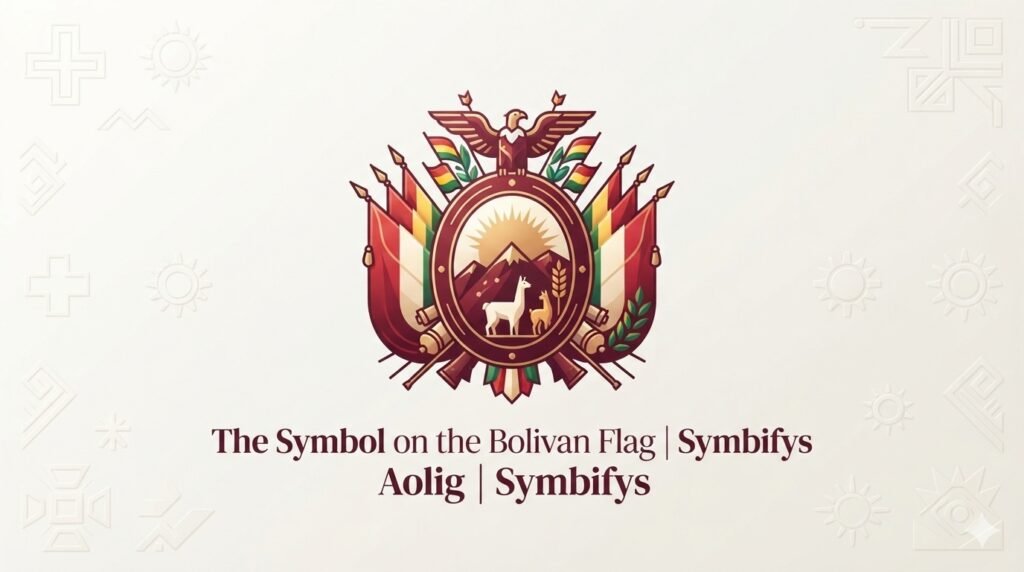
If you have ever looked closely at the Bolivian flag and wondered what the symbol on the Bolivian flag means, you are not alone. The emblem in the center is much more than a decorative design. It is the Bolivian coat of arms, and its individual elements tell a story about the country’s landscape, natural resources, history, independence, and national identity.
There is also an important detail that often causes confusion: not every official Bolivian flag has the coat of arms displayed in the center. Bolivia’s ordinary national tricolor consists of three horizontal bands—red, yellow, and green. Government and military versions can include the national coat of arms in the yellow band.
So, when someone asks, “What does the symbol on the Bolivian flag mean?” they are usually asking about that detailed central emblem.
Understanding it becomes much easier when you look at the emblem as a visual story rather than a collection of random objects.
What Does the Symbol on the Bolivian Flag Mean? – Quick Meaning
The symbol on the Bolivian state flag is the national coat of arms of Bolivia. It represents important parts of Bolivia’s geography, history, economy, independence, and national identity.
In simple terms, the emblem communicates ideas such as:
- National identity — it identifies Bolivia as a sovereign nation.
- Natural wealth — mountains, agriculture, and other resources are represented.
- History and independence — weapons and other elements recall the country’s struggle for freedom.
- National strength — the condor and surrounding elements give the emblem a strong patriotic character.
- Geography — the landscape inside the shield reflects Bolivia’s distinctive Andean environment.
The flag itself has three colors. Bolivia’s official symbolism identifies red with the blood shed by heroes in the birth and preservation of the republic, yellow with mineral and underground wealth, and green with the richness of nature and hope.
You might hear someone say:
“It’s Bolivia’s coat of arms.”
Or:
“The symbol represents Bolivia’s history and natural wealth.”
Another simple explanation is:
“It’s the national emblem, not a random symbol.”
Origin & Background of the Bolivian Flag Symbol
To understand the emblem, it helps to step back into Bolivia’s history.
Bolivia became independent from Spanish rule in 1825, and the country’s national symbols developed during the years that followed. The flag went through earlier versions before the red-yellow-green arrangement was established in 1851. A Bolivian law dated November 5, 1851, formally placed red at the top, yellow in the middle, and green at the bottom and also referred to the Bolivian condor as part of the national symbolism.
The modern national tricolor therefore has deep historical roots rather than being a recent design.
Bolivia’s 2004 Supreme Decree No. 27630 standardized the national flag and clarified how different versions should be used. It states that the national flag consists of three equal horizontal stripes: red, yellow, and green. It also specifies that flags used by major government institutions, embassies, and certain official bodies carry the national coat of arms in the center of the yellow stripe.
That distinction matters.
If you see a simple red-yellow-green Bolivian flag, there is nothing missing. It is a legitimate form of the national flag.
If you see the detailed emblem in the center, you are generally looking at an official/state version of the flag.
What is inside the coat of arms?
The coat of arms contains several visual elements associated with Bolivia’s national story.
The central shield presents a landscape that includes Mount Potosí, an important symbol of Bolivia’s historic mineral wealth. Other imagery represents agriculture and natural resources.
Around the shield are additional elements, including weapons, flags, branches, and a Bolivian Andean condor at the top.
The condor is particularly striking because it connects the emblem to the Andes and gives the entire design a sense of height, strength, and national pride.
The emblem has changed in form over Bolivia’s history, which explains why older images of the Bolivian coat of arms may look somewhat different from the modern version.
Why does the flag have three colors?
The symbolism of the tricolor is officially defined.
Red represents the blood shed by the country’s heroes for the birth and preservation of the republic.
Yellow represents Bolivia’s mineral wealth and natural resources beneath the ground.
Green represents the richness of nature and hope.
Together, the colors create a simple visual sequence: sacrifice, wealth, and hope.
That gives the flag emotional meaning as well as political identity.
Real-Life Conversations
People often encounter the Bolivian flag online without knowing why some versions contain an emblem and others do not. Here are a few realistic examples of how the question might come up.
Person A:
Why does the Bolivian flag in this photo have a symbol in the middle?
Person B:
That’s Bolivia’s coat of arms. Some official versions of the flag include it.
Person A:
So the plain red, yellow, and green one isn’t different?
Person B:
It’s still the Bolivian national flag. The emblem version is used in specific official contexts.
Instagram DM
Person A:
I was looking at Bolivia’s flag and noticed the little mountain and bird.
Person B:
Yeah, that’s the national coat of arms.
Person A:
Does everything on it mean something?
Person B:
Pretty much. The imagery connects to Bolivia’s history, landscape, resources, and independence.
TikTok Comments
Commenter 1:
What does the symbol on the Bolivian flag mean?
Commenter 2:
It’s the Bolivian coat of arms.
Commenter 3:
And the colors have meanings too—red, yellow, and green aren’t random.
Commenter 2:
Exactly. It’s basically a visual summary of the country’s history and identity.
Text Messages
Person A:
Is that Bolivia’s flag? I thought theirs was just red yellow green.
Person B:
It is. You’re looking at the state version with the coat of arms.
Person A:
Ohhh, so that’s why I’ve seen two versions.
Person B:
Exactly.
Emotional & Psychological Meaning
National symbols work differently from ordinary symbols.
A traffic sign tells you what to do. An emoji expresses a mood. A national emblem can carry generational memory.
For many people, seeing a national flag can immediately create feelings of belonging, pride, family, history, or home.
The Bolivian coat of arms works in that way. It does not communicate one simple emotion like happiness or sadness. Instead, it brings together several ideas about what the country represents.
The condor can evoke strength and the Andean landscape.
The mountains and natural-resource imagery remind viewers of the country’s physical and economic history.
The weapons and other historical elements point toward independence and national defense.
The surrounding design creates the feeling that these individual pieces belong to one larger national story.
Imagine a Bolivian living far from home and seeing the flag at an international cultural event. The emblem may not feel like merely an illustration. It can become a visual reminder of birthplace, family, language, traditions, and memories.
That is one reason national symbols remain powerful even in an age dominated by digital communication.
Usage in Different Contexts
Social Media
On Instagram, TikTok, Facebook, and other platforms, people commonly use the Bolivian flag emoji 🇧🇴 or images of the flag to identify nationality, celebrate Bolivia, discuss travel, support cultural events, or show national pride.
The digital flag usually appears without the detailed coat of arms because emoji designs simplify national flags.
So don’t assume that the emoji’s appearance means the physical flag always looks exactly the same.
Friends & Relationships
Friends might use the Bolivian flag when talking about someone’s background, food, music, travel, football, family, or cultural traditions.
For example:
“My friend’s family is from Bolivia 🇧🇴.”
Here, the flag primarily communicates identity or connection.
Work & Professional Settings
In professional contexts, the Bolivian flag can appear at embassies, government events, international conferences, educational programs, cultural exhibitions, and diplomatic occasions.
Because national symbols can carry formal significance, accuracy matters more in these settings.
Casual vs. Serious Tone
Using 🇧🇴 in a casual social-media post is usually straightforward.
Displaying an official-looking coat of arms in a government or ceremonial context is more serious because the emblem represents the state.
The context determines how much symbolic weight the image carries.
When NOT to Use It
There is no general rule that says you cannot use the Bolivian flag casually. However, context and respect matter.
Avoid using the symbol in ways that deliberately mock Bolivia, its people, or its national identity.
Be especially careful when altering an official emblem for political satire, commercial branding, or provocative content. A joke that seems harmless to one person may feel disrespectful to someone who has a strong cultural or national connection to the symbol.
Another common mistake is using the coat of arms as though it were simply an interchangeable decorative logo.
It is a national symbol with historical significance.
If you are creating educational, governmental, ceremonial, or professional material, check that the version you use is accurate.
Common Misunderstandings
“The symbol is always on the Bolivian flag.”
Not necessarily.
Bolivia’s national tricolor can appear without the coat of arms. Official regulations distinguish between ordinary public use and versions used by government institutions and the armed forces.
“The symbol is just a logo.”
No.
The central emblem is the national coat of arms, and its components have historical and national significance.
“The three colors are decorative.”
They are not.
Official descriptions give specific meanings to red, yellow, and green.
“The bird is just decoration.”
The condor has an important place in the national emblem and connects the design to Bolivia’s Andean identity.
“Every image of the Bolivian flag should look identical.”
Different official contexts can use different versions of the national symbols, which is one reason people encounter both the plain tricolor and the emblem-bearing flag.
Comparison Table
| Symbol or Expression | Meaning | Typical Context |
|---|---|---|
| 🇧🇴 Bolivian flag emoji | Bolivia, Bolivian identity, pride | Social media |
| Plain red-yellow-green flag | National identity | Public and everyday display |
| Bolivian coat of arms | State, history, sovereignty, national heritage | Official contexts |
| Red stripe | Historical sacrifice and blood of heroes | National symbolism |
| Yellow stripe | Mineral and underground wealth | National symbolism |
| Green stripe | Nature and hope | National symbolism |
| Andean condor | Strength and connection to the Andes | Coat of arms |
| Wiphala | Indigenous and plural national identity | Cultural and national contexts |
| National emblem | Formal representation of the state | Government and ceremonial use |
| 🇧🇴 + cultural text | Pride or connection to Bolivia | Online communication |
Key Insight
The most important distinction is simple: the red-yellow-green design is the national tricolor, while the detailed central emblem is Bolivia’s coat of arms used on particular official versions of the flag. Knowing this prevents one of the most common misunderstandings about the symbol.
Variations / Types
Here are 10 related forms or elements you may encounter.
1. Plain Bolivian Tricolor
The red-yellow-green national flag without the coat of arms.
2. State Flag
The tricolor displayed with the national coat of arms in the center.
3. Military Version
A version used by Bolivia’s armed forces with additional symbolic details specified by national regulations.
4. Coat of Arms
The detailed national emblem containing Bolivia’s historical and geographical imagery.
5. Red Stripe
Represents the blood shed by heroes in the country’s history.
6. Yellow Stripe
Represents Bolivia’s mineral and underground wealth.
7. Green Stripe
Represents natural richness and hope.
8. Condor
The prominent bird positioned above the central emblem.
9. Potosí Mountain
The mountain imagery reflects Bolivia’s historic connection with mineral wealth and the landscape of the Andes.
10. Bolivian Flag Emoji 🇧🇴
A simplified digital representation commonly used in online communication.
How to Respond When Someone Uses It
If someone sends you 🇧🇴 or talks about the Bolivian emblem, your response can depend on the conversation.
Casual Replies
- “Bolivia! 🇧🇴”
- “That’s the Bolivian flag, right?”
- “Love the colors.”
Funny Replies
- “Okay, geography lesson unlocked. 🇧🇴”
- “That flag has more history than I expected!”
- “I finally know what that middle symbol is.”
Mature Replies
- “The central design is Bolivia’s national coat of arms.”
- “The emblem represents important parts of Bolivia’s history and national identity.”
- “The colors have official symbolic meanings as well.”
Respectful Replies
- “It’s a beautiful national symbol.”
- “I didn’t realize how much history was represented in the emblem.”
- “Thanks for explaining the symbolism.”
The best response is often simply showing genuine curiosity.
Regional & Cultural Usage
National symbols can feel different depending on who is viewing them.
Western Culture
In the United States, Canada, and much of Western Europe, the Bolivian flag may most commonly appear in travel content, international events, sports, diaspora communities, educational materials, and online discussions.
Someone unfamiliar with Bolivia may see it primarily as a country identifier.
Asian Culture
Across Asian countries, the flag may appear in educational, diplomatic, tourism, and international-event contexts.
Because people may encounter many unfamiliar national flags online, questions about the meaning of the emblem are natural rather than disrespectful.
Middle Eastern Culture
In Middle Eastern contexts, the Bolivian flag may appear in international business, education, diplomacy, travel, and multicultural communities.
As with any national emblem, understanding the cultural context helps avoid treating it as merely decorative.
Global Internet Usage
Online, the flag has become much more flexible.
People use 🇧🇴 to indicate nationality, ancestry, travel, food, football, music, celebrations, political discussion, or simple interest in Bolivia.
The internet also means people frequently encounter simplified or stylized versions of national symbols.
Gen Z vs. Millennials
Younger users are more likely to use the flag as part of short-form digital communication.
A Gen Z user might simply add 🇧🇴 to a TikTok caption without explaining anything.
A Millennial user might use the flag in a travel post, professional profile, or cultural discussion.
Neither use automatically carries a different official meaning. The difference is mainly in communication style and context.
Is It Safe for Kids?
Yes. The Bolivian flag and its national coat of arms are ordinary cultural and educational symbols.
Children can learn about them through geography lessons, history projects, international-day activities, or discussions about world cultures.
The most useful approach is to explain the symbols in age-appropriate language.
For a young child, you might say:
“The red, yellow, and green colors are part of Bolivia’s national flag, and the picture in the middle is the country’s coat of arms.”
Older children can learn about the historical meanings behind the colors and the imagery inside the emblem.
FAQs
1. What does the symbol on the Bolivian flag mean?
The symbol is Bolivia’s national coat of arms. It represents the country’s history, geography, natural resources, independence, and national identity.
2. What is the bird on the Bolivian coat of arms?
The bird is an Andean condor, a powerful symbol associated with Bolivia’s Andean environment and national identity.
3. What do the colors of the Bolivian flag mean?
Red represents the blood shed by national heroes, yellow represents mineral and underground wealth, and green represents natural richness and hope.
4. Does every Bolivian flag have the coat of arms?
No. The ordinary national tricolor can be displayed without the coat of arms. Certain official versions include the emblem in the center.
5. When was the current Bolivian flag adopted?
The red-yellow-green arrangement was established in 1851 and has remained the basis of Bolivia’s national flag.
6. What does the yellow stripe on Bolivia’s flag represent?
The yellow stripe represents Bolivia’s mineral and underground wealth.
7. Why does the Bolivian flag have an emblem in some pictures but not others?
Different versions are intended for different uses. Government and certain official settings use the coat of arms, while ordinary public displays commonly use the plain tricolor.
Conclusion
So, what does the symbol on the Bolivian flag mean?
It is the coat of arms of Bolivia, and it serves as a visual expression of the country’s history, landscape, resources, independence, and national identity.
The flag becomes even more meaningful when you understand its colors. Red recalls historical sacrifice, yellow points to mineral wealth, and green represents nature and hope.
The most useful thing to remember is that the plain red-yellow-green flag and the emblem-bearing version are not two unrelated flags. They are connected forms of Bolivia’s national symbolism, used in different contexts.
And that is what makes national symbols fascinating: a design that may look complicated at first can become surprisingly understandable once you know the story behind it.
descover more post
What Does the Masonic Symbol Mean Square and …
What Does the Steering Wheel Symbol Mean Warning Lights …
What Does the At Symbol Mean @ Meaning Uses 2026

Klevin is a language and digital content writer with over 6 years of experience creating engaging, reader-focused articles. As a contributor at Symbifys.com, he specializes in explaining internet slang, text abbreviations, symbols, emojis, and modern communication trends in a clear and easy-to-understand way. His writing combines thorough research with practical examples, helping readers quickly find accurate answers. Klevin is committed to producing trustworthy, SEO-friendly content that is both informative and enjoyable to read. His goal is to make complex topics simple, useful, and accessible for every visitor.