The symbol & is one of those characters people see almost every day without always knowing its full meaning. It appears in business names, text messages, social media posts, books, websites, menus, logos, and even computer code.
So, what does this symbol mean &?
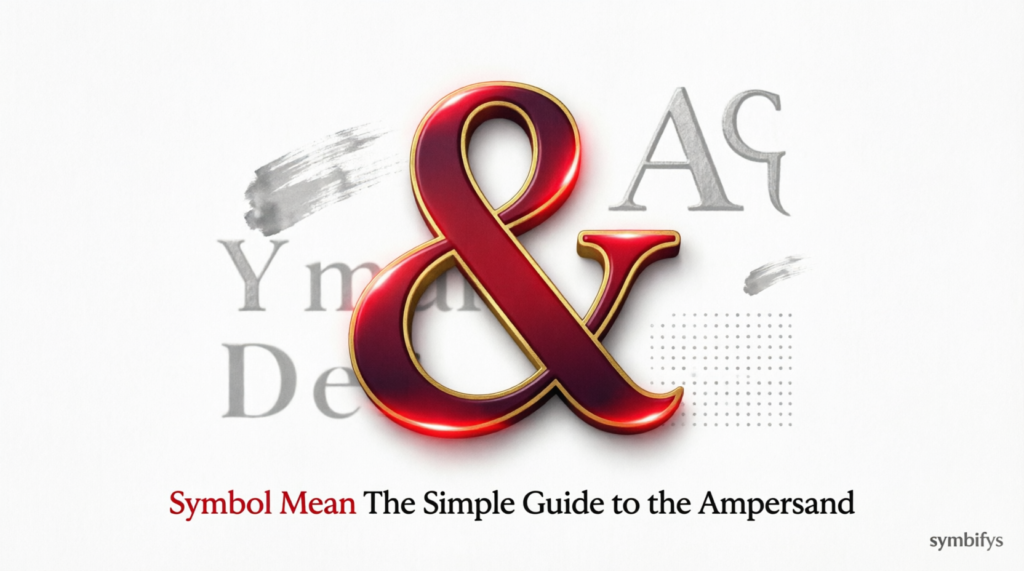
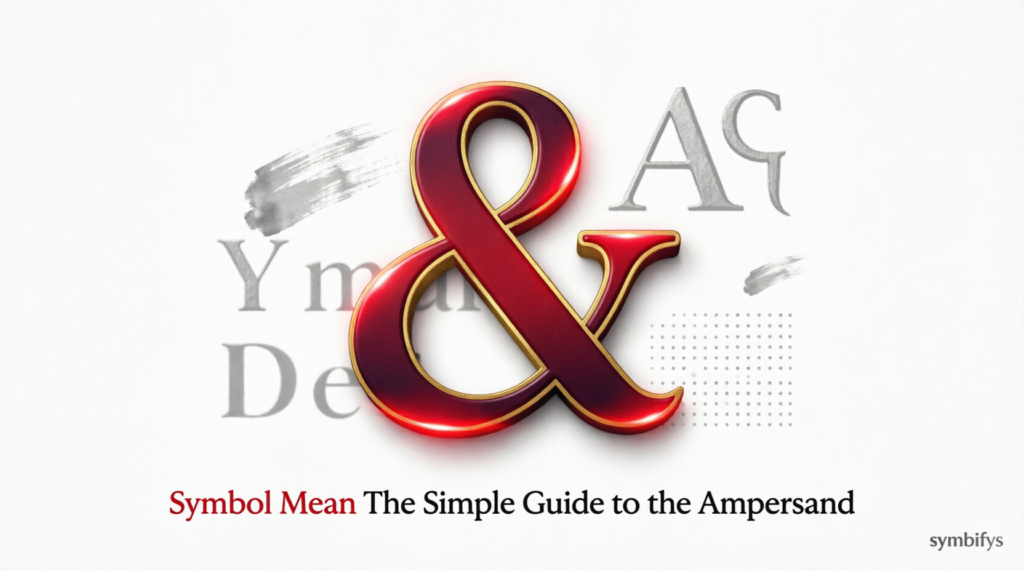
In ordinary writing, & means “and.” It is called an ampersand and is a shortened form of the word “and.” For example, “salt & pepper” means “salt and pepper.”
Although its basic meaning is simple, the symbol has a surprisingly interesting history. It has also developed different uses depending on whether you are writing a formal document, sending a quick message, designing a logo, or working with programming languages.
Understanding the difference between & and the word and can help you write more naturally and choose the right style for different situations.
What Does This Symbol Mean &? – Quick Meaning
The symbol & means “and.”
It is called an ampersand.
In everyday writing, it connects two words, names, ideas, or items.
For example:
- Tom & Jerry = Tom and Jerry
- Research & Development = Research and Development
- Coffee & cake = Coffee and cake
- Love & friendship = Love and friendship
You might see someone write:
“You & I should talk.”
The meaning is:
“You and I should talk.”
Another example is:
“Bread & butter.”
This simply means:
“Bread and butter.”
The symbol is therefore not normally a mysterious code or secret abbreviation. In standard English, its central meaning is and.
However, there is an important style difference.
In formal prose, the word and is usually preferred:
Formal:
“We discussed the proposal and its possible risks.”
More casual/design-oriented:
“We discussed the proposal & its possible risks.”
The second version is understandable, but the first is generally more appropriate for polished formal writing.
Origin & Background
The ampersand has a much older history than many people realize.
Its origin is connected to the Latin word et, which means “and.” Ancient and medieval scribes developed shorthand forms of letters and words to make writing faster and more efficient.
Over time, the letters representing e and t were combined into a single character. That combined form gradually developed into the symbol & that we recognize today.
The modern ampersand therefore isn’t simply a random decorative mark. It evolved from a historical way of writing the word et more efficiently.
Where Did the Word “Ampersand” Come From?
The name itself has an amusing history.
For a long time, the symbol was treated almost like another character in the alphabet.
When people recited the alphabet, they could say something like:
“X, Y, Z, and per se and.”
The expression “and per se and” essentially meant “and, by itself, means and.”
Over time, that spoken phrase gradually became “ampersand.”
So the word ampersand is actually connected to an old way of describing the symbol.
Cultural Influence
The ampersand became particularly popular in typography because it can look more compact and visually distinctive than the word and.
Designers often use it in:
- Restaurant names
- Fashion brands
- Publishing
- Architecture
- Advertising
- Company names
- Wedding invitations
- Event titles
The character can also communicate a sense of connection.
A name such as “Smith & Sons” can feel traditional, while “Music & Art” can feel creative and contemporary.
Social Media Impact
Social media has made the symbol even more visible.
Character limits and fast communication encourage people to use compact forms.
Someone might post:
“Coffee & good music ☕🎵”
instead of:
“Coffee and good music.”
In captions, usernames, hashtags, and visual designs, the ampersand can also look cleaner and more attractive.
Its meaning has not fundamentally changed, but its stylistic role has become more noticeable.
Real-Life Conversations
WhatsApp Conversation
Person A:
“Are you coming for dinner & a movie?”
Person B:
“Definitely 😂 What time?”
Person A:
“7?”
Person B:
“Perfect.”
Here, & simply means and. It makes the message short and casual.
Instagram DM
Person A:
“Your bio says ‘Books & coffee.’ Honestly, same 😂”
Person B:
“Two things I can’t live without.”
Person A:
“Valid.”
The ampersand works naturally because Instagram communication is generally informal and visual.
TikTok Comments
Person A:
“Music & late-night drives >>>”
Person B:
“That combination is unbeatable.”
Person C:
“Especially when it’s raining 😭”
Here, the symbol contributes to the relaxed style of the comment rather than changing the meaning.
Text Message
Person A:
“Mom & Dad are coming tomorrow.”
Person B:
“Oh nice! Are they staying overnight?”
Person A:
“Yeah, probably.”
Again, the symbol has exactly the same basic meaning as and.
Emotional & Psychological Meaning
The ampersand itself does not normally express a particular emotion.
Unlike an emoji such as ❤️ or 😂, it is primarily a linguistic symbol.
However, the way people use it can influence the feeling of a message.
For example:
“Love and friendship”
feels straightforward.
“Love & friendship”
may feel slightly more compact, modern, or visually polished.
This is especially noticeable in branding and design.
A company might choose an ampersand because the character creates a visual connection between two ideas.
Consider:
“Beauty & Balance”
The two words appear visually connected.
That can subtly reinforce the idea that the concepts belong together.
In everyday communication, people may also use & simply because it feels quicker.
I have often noticed that when people are texting quickly, they naturally shorten expressions without thinking about grammar rules. The ampersand fits that habit perfectly because one small character replaces three letters.
That doesn’t make it better or worse than and. It simply makes it more compact.
Usage in Different Contexts
Social Media
The ampersand is perfectly natural in casual online communication.
Examples include:
- “Food & travel”
- “Friends & family”
- “Work & life”
- “Coffee & conversations”
It can make captions look cleaner, particularly when the words are being used as a visual phrase.
Friends & Relationships
Friends often use & in texts because texting tends to favor speed.
For example:
“You & me tonight?”
This is completely understandable in a casual conversation.
In a romantic context, the symbol can sometimes make a phrase look more polished:
“You & me, always.”
The meaning is still simply “you and me.”
Work & Professional Settings
Professional usage depends on the situation.
The ampersand is appropriate in some established names:
Johnson & Johnson
or traditional business-style names:
Barnes & Company
It can also be used in headings, branding, or department names.
However, when writing formal paragraphs, reports, applications, or academic work, spelling out and is generally the safer choice unless a style guide says otherwise.
Casual vs. Serious Tone
A useful rule is:
Casual writing:
The ampersand is often fine.
Formal writing:
Prefer and unless there is a specific reason to use &.
This isn’t an absolute grammatical law. It is primarily a matter of writing style and convention.
When NOT to Use It
Don’t Automatically Replace Every “And”
Replacing every occurrence of and with & can make a formal document look less polished.
For example:
Less formal:
“The study examines social behavior & communication.”
More formal:
“The study examines social behavior and communication.”
Avoid It in Academic Writing Unless Allowed
Many academic style guides have specific rules about ampersands.
For example, some citation systems use & in particular reference-list situations, while ordinary prose generally uses and.
Always follow the required style guide.
Don’t Use It to Sound More Professional
An ampersand does not automatically make writing sophisticated.
Sometimes simple and is actually clearer.
Be Careful With Official Documents
For legal, governmental, academic, or business documents, follow the required formatting conventions rather than choosing the symbol simply because it looks attractive.
Common Misunderstandings
“& Means Something Different From And”
Usually, no.
In ordinary English, & means “and.”
The difference is mainly one of presentation and context.
“Ampersand Is a Type of Abbreviation”
It is better understood as a symbol representing the word “and.”
It has a historical development from the Latin et.
“It Is Only Used Online”
Not at all.
The ampersand has been used in writing and typography for centuries and appears in business names, publishing, signs, advertising, and formal naming conventions.
“You Should Always Use & Instead of And”
No.
The two forms serve different stylistic purposes.
In polished prose, and is usually the natural choice.
“The Symbol Has Only One Meaning Everywhere”
Not necessarily.
In normal English writing, it means and, but the character can have specialized meanings in areas such as programming, mathematics, computing, and technical notation.
Its meaning should therefore be judged from context.
Comparison Table
| Expression | Meaning | Typical Context |
|---|---|---|
| & | And | Casual writing, names, design |
| and | And | Standard and formal writing |
| + | Plus/addition | Mathematics, informal shorthand |
| / | Or, per, or separation | Dates, alternatives, technical writing |
| vs. | Versus | Comparisons |
| also | In addition | Formal and general writing |
| as well as | In addition to | More formal writing |
| with | Together with | General writing |
| between | Connecting two or more sides | Relationships/comparisons |
| and/or | And or one of the alternatives | Specialized/formal contexts |
Key Insight
The & symbol usually means exactly what the word “and” means, but choosing between them is often a matter of style. Use & when it suits the context, and use and when clarity and formal tone matter most.
Variations / Types
The ampersand can appear in several practical forms and contexts.
1. Standard Ampersand (&)
Meaning: The ordinary symbol for “and.”
It is the version most people recognize.
2. Business Ampersand
Meaning: Used as part of an organization’s or company’s name.
Traditional business names frequently include an ampersand.
3. Decorative Ampersand
Meaning: A visually styled version of the symbol.
Designers often create elaborate ampersands for invitations, logos, and branding.
4. Typography Ampersand
Meaning: A character whose appearance varies by typeface.
Different fonts can make the ampersand look dramatically different.
5. Social Media Ampersand
Meaning: A compact way to write “and.”
It is especially common in captions, bios, and informal posts.
6. Branding Ampersand
Meaning: A symbol used to create a recognizable visual identity.
It can make two words appear connected and balanced.
7. Business-Name Ampersand
Meaning: Connects names or business partners.
For example, a traditional firm might use a structure such as “Smith & Brown.”
8. Double Ampersand
Meaning: && has a specialized meaning in some programming languages.
In languages such as Java, it commonly represents a logical AND operation rather than ordinary written English.
9. Ampersand in URLs
Meaning: & can separate parameters in certain web addresses.
This is a technical use rather than an English-language use.
10. HTML Ampersand
Meaning: The character has a special role in HTML.
For example, HTML character references use & as part of their syntax.
How to Respond When Someone Uses It
If someone uses & in a message, you normally don’t need to interpret it as slang.
Simply read it as “and.”
Casual Replies
Person A:
“Pizza & a movie?”
You:
“Absolutely!”
Funny Replies
Person A:
“Coffee & deadlines.”
You:
“The official adult starter pack 😂”
Mature Replies
If someone writes:
“Work & family are both important.”
You can respond normally:
“I agree. Finding a balance between them can be difficult.”
Respectful Replies
There is no special response required simply because someone used an ampersand.
Treat it as you would the word and.
Regional & Cultural Usage
The ampersand has broad international recognition.
Its practical meaning is generally consistent, but the way people use it can differ according to writing traditions and communication styles.
Western Culture
The symbol is common in English-speaking countries, particularly in business names, advertising, publishing, and design.
It often gives a phrase a compact or professional visual appearance.
Asian Culture
The symbol is widely recognizable in countries where English is used in education, business, technology, and online communication.
It may appear in English-language branding and social media even when the surrounding conversation uses another language.
Middle Eastern Culture
The ampersand is commonly encountered in English-language business names, technology, education, advertising, and online communication.
Its basic English meaning remains “and.”
Global Internet Usage
The internet has made & almost universally recognizable.
People can understand phrases such as:
“Food & Travel”
even if English is not their first language.
Gen Z vs. Millennials
Both generations use the symbol, but context matters more than age.
Younger users may use it heavily in captions, aesthetics, usernames, and short messages.
Millennials may encounter it more often in business names, branding, workplace communication, and traditional typography.
Neither generation has a completely different meaning for the symbol.
Is It Safe for Kids?
Yes. The ampersand is an ordinary punctuation and typographic symbol.
Children can safely learn that & means “and.”
For young learners, a simple example works well:
“Cats & dogs” means “cats and dogs.”
Older students should also learn that formal writing often prefers the complete word and.
If children later study programming, they may discover that & and && can have additional technical meanings.
FAQs
1. What does the symbol & mean?
The symbol & usually means “and.” It is called an ampersand.
2. What is the name of the & symbol?
The & symbol is called an ampersand.
3. Is & the same as and?
In ordinary English, yes. The ampersand is a symbol representing the word and.
4. Is it okay to use & in formal writing?
It depends on the style and context. In ordinary formal prose, spelling out and is generally preferred.
5. Why is it called an ampersand?
The name developed from the old phrase “and per se and,” which described the symbol as meaning “and” by itself.
6. What is the difference between & and &&?
In ordinary English, & means “and.” In programming, && can have a special logical meaning, depending on the language.
7. Where is the ampersand commonly used?
It is common in business names, branding, headings, casual messages, social media, typography, and technical contexts.
Conclusion
So, what does this symbol mean &?
The answer is simple: & usually means “and.”
It is called an ampersand, and its history goes back centuries to older shorthand forms of writing. Today, it appears everywhere from company names and logos to text messages, social media captions, books, websites, and technical systems.
The main thing to remember is that & and and have the same basic meaning, but they do not always have the same stylistic effect.
If you’re texting a friend, writing a caption, or creating a visual phrase, & can feel natural and compact.
If you’re writing an academic essay, formal report, or professional paragraph, and is often the better choice unless a specific style requires the symbol.
Once you understand that distinction, the ampersand becomes much less mysterious. It’s a small character with a long history—and one simple message at its heart: connection.
descover more post
What Does Prince’s Symbol Mean The Story Behind …
What Does the Butterfly Symbol Mean 12 Powerful …
What Does the Rock Symbol Mean A Complete Guide to Its …

Mia Enderson is a dedicated content writer and digital research specialist with over 7 years of experience creating insightful and reader-focused content. She specializes in technology, business, and online trends, delivering well-researched and engaging articles. At Symbifys.com, Mia is committed to providing accurate, valuable, and easy-to-understand information that helps readers make informed decisions. Her passion for quality content and attention to detail have earned the trust of a growing audience.