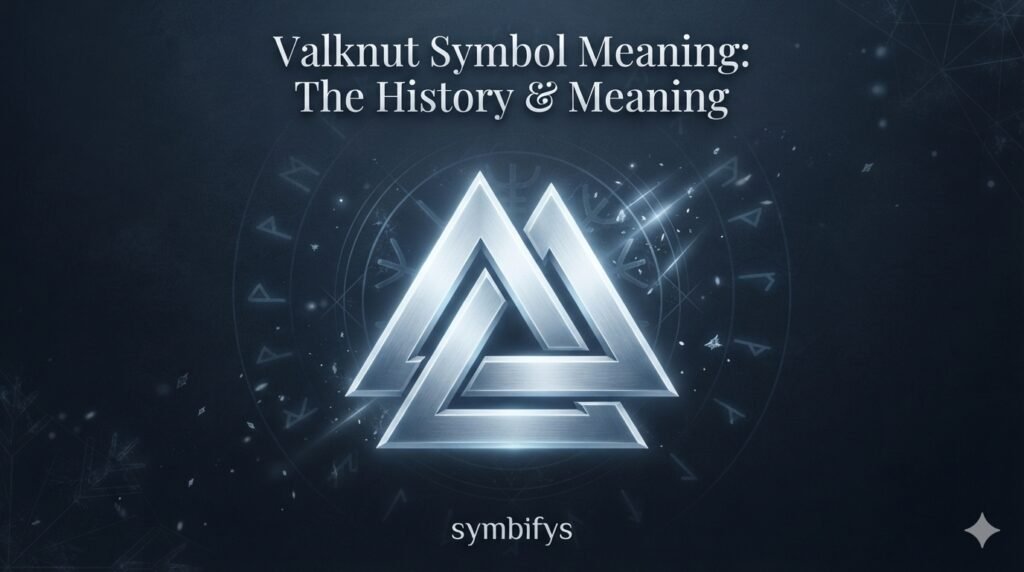
If you have ever seen three interlocking triangles and wondered, “What does the Valknut symbol mean?”, you are looking at one of the most recognizable symbols associated with Norse culture.
The Valknut is commonly connected with Odin, death, warriors, the afterlife, and the mysterious transition between life and death. It appears in Viking Age artwork and picture stones, sometimes alongside figures, animals, weapons, ships, and scenes that have been interpreted as relating to Odin or the dead.
But there is an important detail that is often missed online: historians do not have a surviving Viking Age explanation that definitively tells us what the symbol meant.
The modern name “Valknut” is also not a name that can be securely shown to have been used by Vikings themselves. It is a modern term generally understood as referring to the “knot of the slain” or fallen.
That uncertainty does not make the symbol meaningless. Quite the opposite.
Its archaeological context, especially its association with burial imagery and Odin, has made it a powerful symbol of mortality, transformation, courage, mystery, and the passage from one state of existence to another.
Today, people encounter the Valknut on jewelry, tattoos, artwork, clothing, social-media profiles, gaming designs, and modern Norse-inspired communities.
Understanding its history helps you use it with more confidence—and with greater respect for the culture behind it.
What Does the Valknut Symbol Mean? – Quick Meaning
The Valknut is a symbol made from three interlocking shapes, usually appearing as three connected triangles.
Its exact ancient meaning remains uncertain, but it is strongly associated by modern scholars with themes surrounding Odin, death, fallen warriors, and the journey between worlds.
A simple way to understand its commonly interpreted symbolism is:
- Death and mortality — The symbol frequently appears in contexts connected with death or burial.
- Odin — Several archaeological examples place Valknut-like designs near imagery associated with Odin.
- The afterlife — It is often connected with the idea of a warrior’s passage after death.
- Transformation — The interlocking structure can be interpreted symbolically as connection between different states or worlds.
- Courage — In modern use, it can represent bravery, strength, and acceptance of mortality.
- Mystery and spiritual power — Its uncertain ancient meaning contributes to its modern mystical appeal.
For example, someone might explain it by saying:
“The Valknut represents the mystery of life and death.”
Another person might say:
“I wear the Valknut because I connect it with Odin and warrior courage.”
Or:
“For me, it represents accepting that life is temporary.”
These are modern interpretations rather than proven Viking Age definitions.
That distinction matters.
Origin & Background
The Valknut is associated with the wider religious and artistic world of pre-Christian Scandinavia.
Several Viking Age and earlier Germanic objects contain designs that resemble what is now called the Valknut. One important example is found on picture stones from Gotland, Sweden.
The Swedish History Museum describes a picture stone from Stånga on Gotland that includes a symbol identified as a triquetra or valknut behind a seated man. The surrounding imagery is complex, and the exact relationship between the scenes remains uncertain.
Another Gotlandic picture stone from Lillbjärs shows a fallen-hero or Valhalla-related scene together with both a triquetra and a more complex Valknut-like design. The museum notes that the exact story represented by the stone cannot be established with certainty.
This is why responsible explanations avoid saying, “The Vikings definitely believed this symbol meant X.”
The archaeological evidence is more complicated.
Why is it associated with Odin?
Odin was one of the most complex figures in Norse mythology.
He was associated with wisdom, war, death, poetry, magic, and knowledge. The Swedish History Museum describes him as both a god of war and a god of the dead, with half of the warriors who died in battle said to come to his hall, Valhalla.
Some archaeological depictions containing Valknut-like designs also include imagery that has been interpreted as Odin.
This connection has encouraged the popular interpretation of the Valknut as an Odinic symbol related to death and the afterlife.
However, scholars continue to debate precisely what the design represented.
Another possible connection is the heart of Hrungnir, a three-cornered heart described in later Old Norse literature. Some researchers have compared this description with Valknut-like imagery, although the identification is not certain.
How did the meaning evolve?
The symbol’s modern popularity is much broader than its archaeological evidence.
Today, the Valknut appears in tattoos, jewelry, fantasy art, video games, social-media posts, alternative spirituality, historical reconstruction, and Norse-inspired fashion.
Social media has also simplified its meaning.
A complicated archaeological symbol can quickly become “Odin symbol,” “Viking warrior symbol,” or “death symbol” in a short caption.
Those descriptions may capture part of the modern interpretation, but they should not be treated as definitive translations of an ancient belief.
The most historically careful description is that the Valknut is a Viking Age-associated symbol whose precise original meaning is uncertain but whose archaeological contexts strongly connect it with themes of death, Odin, and the passage between worlds.
Real-Life Conversations
WhatsApp Conversation
Person A:
I keep seeing this three-triangle symbol on Viking necklaces. Do you know what it means?
Person B:
You mean the Valknut?
Person A:
Yes! Is it basically an Odin symbol?
Person B:
It’s strongly associated with Odin and death, but its exact original meaning isn’t completely known.
Person A:
So it isn’t literally just a “Viking symbol”?
Person B:
Right. It’s more specific than that. It has strong connections to Norse ideas about death and warriors.
Instagram DM
Person A:
Thinking about getting a Valknut tattoo. What does it actually mean?
Person B:
Usually people connect it with Odin, fallen warriors, death, and the afterlife.
Person A:
That’s actually deeper than I thought.
Person B:
Yeah. Just remember that the ancient meaning isn’t proven beyond doubt.
Person A:
I like that. I want it to represent accepting life’s uncertainty.
Person B:
That makes sense as a modern personal interpretation.
TikTok Comments
Commenter 1:
Is this the symbol of Valhalla?
Commenter 2:
It’s called the Valknut. People associate it with Odin and the dead.
Commenter 3:
So Vikings used it as a Valhalla logo?
Commenter 2:
Not exactly. We don’t have a definitive Viking explanation of the symbol.
Commenter 3:
Oh, that’s interesting. TikTok made it sound much more certain.
Text Messages
Person A:
Why does your necklace have three triangles?
Person B:
It’s a Valknut.
Person A:
What’s that mean?
Person B:
It’s commonly connected with Odin, death, and the journey to the afterlife.
Person A:
That’s kind of intense.
Person B:
I see it more as courage and accepting mortality.
Person A:
Okay, that actually makes sense.
Emotional & Psychological Meaning
Symbols often become meaningful because people use them to express feelings that are difficult to put into ordinary words.
The Valknut is especially powerful in this respect because its commonly interpreted themes involve life, death, courage, uncertainty, and transformation.
For one person, wearing it may represent strength during difficult times.
For another, it may symbolize remembrance of someone who died.
Someone interested in Norse mythology might use it to express admiration for Odin’s complicated character and his associations with wisdom, sacrifice, knowledge, and death.
Psychologically, symbols like the Valknut can provide a visual reminder of an idea.
A person might look at the three connected forms and think about how different parts of life remain connected: beginning and ending, courage and fear, loss and memory.
A personal-style scenario
Imagine someone who loses a close family member and later discovers the Valknut while learning about Norse mythology.
They may not view it as a literal religious object.
Instead, they may see it as a reminder that death is part of human existence and that remembering someone can keep their influence alive.
That personal interpretation can be meaningful even though it should not be confused with a proven historical definition.
Usage in Different Contexts
Social Media
On social media, the Valknut is often used in profile pictures, captions, tattoos, historical-content posts, and Norse mythology discussions.
A caption such as “Strength beyond fear” gives it a modern motivational meaning.
However, context matters because viewers may interpret the symbol differently.
Friends & Relationships
Among friends, someone might use the Valknut to show an interest in Norse mythology or Viking history.
In a relationship, it could represent loyalty, remembrance, strength, or a shared interest in mythology.
The safest approach is to explain what it means personally rather than assuming everyone understands it in the same way.
Work and Professional Settings
The Valknut is generally not appropriate as a casual professional symbol unless there is a clear reason for using it.
For example, a historian, museum professional, fantasy artist, or cultural researcher may naturally use Norse imagery.
In an unrelated corporate environment, however, an unfamiliar symbol can distract people or create unnecessary questions.
Casual vs. Serious Tone
Casually, the Valknut may simply represent an interest in Viking history.
In serious settings involving death, religion, ancestry, or cultural heritage, it deserves more thoughtful explanation.
When NOT to Use It
The Valknut is not automatically offensive or inappropriate.
However, context can change how a symbol is perceived.
Avoid using it carelessly when:
- You are discussing another person’s religious or cultural traditions.
- You do not understand the historical background.
- You are using it purely as a “cool Viking logo.”
- You are representing yourself as an authority on Norse history without understanding the uncertainty surrounding the symbol.
- The symbol is being used in a context where people could reasonably interpret it as a political or ideological statement.
Modern extremist groups have sometimes appropriated various historical symbols, including symbols associated with Norse culture.
That does not mean every person who wears a Valknut has extremist intentions.
It does mean that context, accompanying symbols, and the stated purpose of use can matter.
Common Misunderstandings
“The Valknut definitely means Valhalla.”
Not necessarily.
Its archaeological associations make a connection with death and the afterlife plausible, but there is no definitive ancient text saying, “This symbol means Valhalla.”
“The name Valknut is the original Viking name.”
This is also uncertain.
“Valknut” is a modern name generally interpreted as referring to the slain or fallen, rather than a securely documented Viking Age name.
“It is simply a death symbol.”
That is too narrow.
Death is an important part of its modern interpretation, but its associations also include Odin, warriors, transition, mystery, and possibly magical or spiritual ideas.
“Every three-triangle symbol is a Valknut.”
Not necessarily.
Similar geometric forms existed in different contexts, and researchers have debated whether certain designs should all be grouped under the same label.
“The symbol has one universally accepted meaning.”
It does not.
The strongest interpretations are based on archaeological context rather than a single surviving definition.
Comparison Table
| Symbol or Expression | Common Meaning | How It Differs From the Valknut |
|---|---|---|
| Valknut | Death, Odin, fallen warriors, transition | A historical symbol with uncertain exact meaning |
| Mjölnir | Thor, protection, strength | More directly associated with Thor’s hammer |
| Vegvísir | Modern symbol of guidance and protection | Often mistakenly presented as an ancient Viking symbol |
| Yggdrasil | World tree, connection between realms | Represents a cosmic structure rather than primarily death |
| Odin’s ravens | Thought, memory, knowledge | Directly connected with Odin through mythology |
| “Rest in peace” | Peace after death | A modern phrase rather than a Norse symbol |
| Memorial symbols | Remembrance and grief | Usually designed specifically around remembrance |
| Warrior imagery | Courage and battle | Broader and less specifically associated with the Valknut |
Key Insight
The Valknut stands out because it sits between history and interpretation. Its strongest archaeological associations are meaningful, but its exact original definition remains uncertain. That makes context more important than a simple one-line translation.
Variations / Types
There is no universally accepted ancient classification system for “types” of Valknut. However, people commonly encounter several visual forms and related interpretations.
1. Three Interlocking Triangles
Meaning: The classic Valknut design.
This is the form most people recognize as the Valknut today.
2. Open-Loop Valknut
Meaning: A variation where the lines appear more visibly interwoven.
It emphasizes the knot-like appearance of the design.
3. Closed Interlocking Form
Meaning: A compact geometric version.
The triangles appear tightly connected, producing a strong symmetrical appearance.
4. Triskele-Like Form
Meaning: A visually related three-part design.
Some symbols can resemble a Valknut without necessarily carrying the same historical meaning.
5. Valknut With Odin Imagery
Meaning: Odin-associated interpretation.
When a Valknut-like symbol appears beside imagery interpreted as Odin, the connection becomes particularly significant.
6. Valknut With Warrior Imagery
Meaning: Fallen warrior or battlefield associations.
Modern interpretations often connect this version with courage, battle, and the afterlife.
7. Valknut in Burial Context
Meaning: Death and remembrance.
Archaeological placement near burial-related imagery is one reason researchers associate the design with mortality.
8. Modern Tattoo Valknut
Meaning: Personal strength, mortality, heritage, or mythology.
Modern tattoo meanings can be much more personal than the ancient evidence allows us to establish.
9. Modern Jewelry Valknut
Meaning: Norse interest or symbolic identity.
People may wear it as a cultural, historical, spiritual, or aesthetic symbol.
10. Minimalist Valknut
Meaning: A simplified modern interpretation.
The design may be reduced to clean lines while retaining its recognizable three-triangle structure.
How to Respond When Someone Uses It
Casual Replies
- “Oh, that’s the Valknut, right?”
- “Is that your Norse mythology symbol?”
- “Interesting choice—what does it mean to you?”
Funny Replies
- “Three triangles and suddenly we’re in Valhalla.”
- “Okay, Viking history just entered the chat.”
- “That symbol definitely has more lore than my entire phone.”
Mature Replies
- “I know it’s associated with Odin and death, but I understand the exact historical meaning is debated.”
- “Interesting symbol. I’d be curious to hear what it represents to you personally.”
Respectful Replies
- “I recognize it as the Valknut. What connection does it have for you?”
- “I know there are different interpretations, so I don’t want to assume what you mean by it.”
The last approach is often the best.
Symbols are personal, and asking someone what a symbol means to them is usually more respectful than telling them what they must mean by using it.
Regional & Cultural Usage
Western Culture
In Europe and North America, the Valknut is commonly associated with Vikings, Norse mythology, Odin, warrior culture, and historical interest.
It is particularly visible in tattoo culture, historical recreation, fantasy media, and alternative fashion.
Asian Culture
In Asian countries, the Valknut is generally encountered through global entertainment, gaming, social media, tattoos, and interest in European mythology.
Its meaning may therefore be understood more as a mythology or aesthetic symbol than as part of a living local tradition.
Middle Eastern Culture
In Middle Eastern online spaces, people may encounter the symbol primarily through international social media, gaming, historical content, or tattoo culture.
Because Norse religious symbolism is outside many local cultural traditions, explaining the intended meaning can prevent confusion.
Global Internet Usage
The internet has transformed the Valknut into a globally recognizable symbol.
A teenager in one country may discover it through a video game, while someone else may encounter it through Viking history content or a tattoo artist.
As a result, the same image can carry very different personal meanings.
Generational Differences
Gen Z users may encounter the Valknut through TikTok, gaming, memes, fashion, tattoos, or short-form mythology content.
Millennials may be more familiar with it through fantasy media, historical documentaries, tattoos, gaming, or earlier internet communities.
Neither generation has a single interpretation.
The important difference is often how the symbol was discovered rather than age itself.
Is It Safe for Kids?
The Valknut is not inherently dangerous for children.
It is a historical and cultural symbol, and learning about it can be a useful introduction to Norse mythology, archaeology, symbolism, and ancient cultures.
The important issue is context.
Parents and educators should explain that modern interpretations are not always the same as historical evidence.
It is also worth teaching children that symbols can be adopted by different groups for different purposes.
Rather than simply labeling the Valknut as “good” or “bad,” children can learn to ask a better question: What does this symbol mean in this particular context?
FAQs
1. What does the Valknut symbol mean?
The Valknut is commonly associated with Odin, death, fallen warriors, the afterlife, and transition between worlds. Its exact original meaning remains uncertain.
2. Is the Valknut a symbol of Odin?
It is strongly associated with Odin in modern scholarship and popular culture because Valknut-like designs appear in contexts containing imagery interpreted as Odin. However, the precise relationship is debated.
3. Does the Valknut mean death?
Death is one of its strongest modern interpretations, partly because Valknut-like designs appear in burial and death-related contexts.
4. Does the Valknut represent Valhalla?
It is often connected with Valhalla and fallen warriors, but there is no definitive surviving Viking Age explanation proving that the symbol specifically meant Valhalla.
5. Is the Valknut a Viking symbol?
It is a symbol associated with Viking Age and pre-Christian Scandinavian imagery, although the modern word “Valknut” and some modern interpretations should not be assumed to be ancient Viking terminology.
6. Is wearing a Valknut offensive?
Not inherently. People wear it for many reasons, including interest in Norse history, mythology, personal symbolism, and art. Context is important because symbols can acquire different meanings in different communities.
7. What does a Valknut tattoo mean?
A Valknut tattoo may represent Odin, mortality, courage, warrior ideals, Norse heritage, remembrance, or personal transformation. The meaning depends largely on the person wearing it.
Conclusion
So, what does the Valknut symbol mean?
The most responsible answer is that it is a powerful Norse-associated symbol connected with Odin, death, fallen warriors, the afterlife, and transition, but its precise original meaning has never been conclusively established.
That uncertainty is actually part of what makes the Valknut fascinating.
It survived not as a simple sentence carved into stone explaining itself, but through images, archaeological contexts, mythology, and generations of interpretation.
Today, one person may see three interlocking triangles and think of Odin.
Another may see courage in the face of death.
Someone else may see remembrance, transformation, or an interest in Viking history.
Those personal meanings can coexist with historical caution.
If you choose to wear, draw, tattoo, or discuss the Valknut, the best approach is not to pretend there is only one answer. Understand its Norse background, recognize the uncertainty surrounding its ancient meaning, and then decide what the symbol means to you.
Sometimes the most meaningful symbols are not the ones with the simplest answers.
They are the ones that make us stop, ask questions, and think about life, death, memory, and what remains after us.
descover more post
What Does the Triangle Symbol With an Exclamation Point …
What Does the Car Symbol With an Arrow Mean A …
What Does the Steering Wheel Symbol Mean Warning Lights …

Mia Enderson is a dedicated content writer and digital research specialist with over 7 years of experience creating insightful and reader-focused content. She specializes in technology, business, and online trends, delivering well-researched and engaging articles. At Symbifys.com, Mia is committed to providing accurate, valuable, and easy-to-understand information that helps readers make informed decisions. Her passion for quality content and attention to detail have earned the trust of a growing audience.