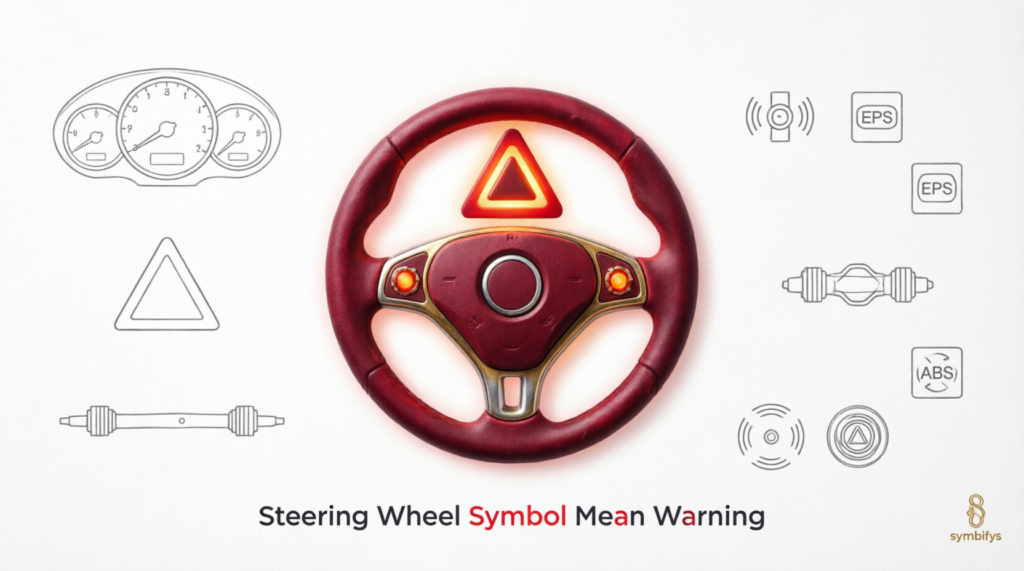
Seeing a steering wheel symbol on your car dashboard can be unsettling, especially when you are driving and suddenly notice a new warning light.
The symbol usually looks like a steering wheel, sometimes with an exclamation mark, and its meaning depends on the vehicle. In many modern cars, it is connected to the power steering system, steering assistance, or an electronic steering-related feature.
A warning light does not always mean your steering wheel itself is broken. It can indicate anything from a temporary electronic issue to a problem that makes steering significantly harder.
Understanding the symbol matters because steering is directly connected to vehicle control. A driver who recognizes the warning early can make a safer decision instead of ignoring an unfamiliar light.
This guide explains what the steering wheel warning symbol means, what its different colors can indicate, why it appears, and what you should do when it comes on.
What Does the Steering Wheel Symbol Mean? – Quick Meaning
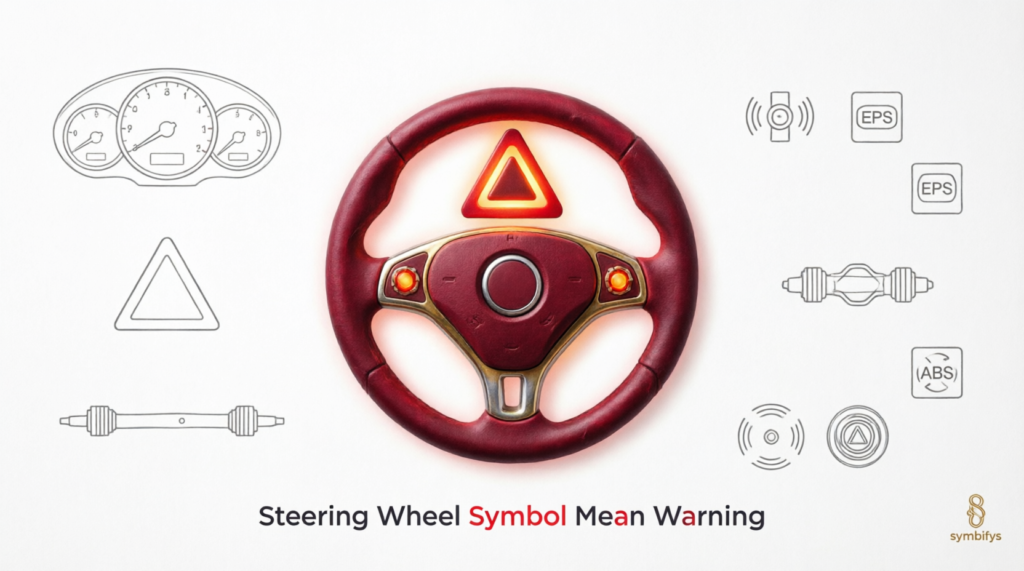
The steering wheel symbol generally indicates a steering-system warning or steering-assistance status.
Depending on the vehicle, it may relate to:
- Electric power steering (EPS)
- Hydraulic power steering
- Electronic steering assistance
- A steering-system malfunction
- Temporary reduced steering assistance
- A steering-related system that needs attention
The exact meaning varies between manufacturers, so your owner’s manual remains the final authority for your specific vehicle.
You might see messages such as:
“Steering assist reduced.”
“Power steering fault.”
“Check steering system.”
A yellow or amber steering wheel symbol commonly indicates a fault or condition that needs attention, while a red steering wheel warning can indicate a more serious problem. However, warning-light colors are manufacturer-specific, so do not rely on color alone.
Origin & Background of the Steering Wheel Symbol
The steering wheel icon comes from a very simple visual idea: represent the system responsible for directing the vehicle with the object drivers already recognize.
Unlike complicated technical abbreviations, a steering wheel is instantly recognizable across languages.
Dashboard symbols developed partly because automobiles became increasingly international. A driver might rent a car in another country without speaking the local language, yet a recognizable steering-wheel icon can communicate the general subject of the warning.
Modern vehicles have made the symbol more sophisticated.
Older vehicles commonly relied on hydraulic power steering, where a pump and hydraulic fluid helped reduce the effort needed to turn the wheel.
Many modern cars instead use electric power steering, which uses an electric motor and electronic controls to provide assistance.
Because electronic steering systems can monitor themselves, modern dashboards may display a steering-wheel symbol when the system detects a fault.
Digital dashboards have also changed how these warnings are presented. Instead of a single illuminated icon, some vehicles combine the symbol with a written message explaining what the driver should do.
This is why two cars can display similar steering-wheel symbols but have slightly different meanings.
The symbol itself has also become familiar online. Drivers frequently post dashboard photographs on Facebook groups, Instagram, Reddit, TikTok, and automotive forums asking, “What does this steering wheel light mean?”
That social-media habit has made dashboard-symbol explanations a common part of everyday car culture.
Real-Life Conversations
Person A:
A steering wheel symbol just came on in my car. Should I panic?
Person B:
What color is it?
Person A:
Yellow.
Person B:
It could be a power-steering warning. Check the owner’s manual and don’t ignore it.
Person A:
The steering still feels normal.
Person B:
That’s good, but I’d still get it checked.
Instagram DMs
Person A:
Do you know what this steering wheel icon means? 😭
Person B:
Is there an exclamation mark beside it?
Person A:
Yes!
Person B:
That usually points to a steering or power-assistance issue. Send me the car model.
Person A:
Okay. I thought the steering wheel itself was locked.
TikTok Comments
Person A:
Why is my steering wheel symbol red?
Person B:
Red dashboard warnings can be serious. Don’t assume it’s just an indicator.
Person A:
The car is still driving normally.
Person B:
I’d stop somewhere safe and check the manual before continuing.
Text Messages
Person A:
My steering wheel light disappeared after I restarted the car.
Person B:
It might have been temporary.
Person A:
So I’m good?
Person B:
Maybe, but if it comes back, get the steering system diagnosed.
Emotional & Psychological Meaning
Unlike a social-media symbol, the steering wheel warning does not normally have an emotional meaning.
Its psychological effect comes from what the steering wheel represents: control.
When drivers see a steering-related warning, they often become anxious because steering is something they depend on every second of a journey.
That reaction is understandable.
A small dashboard light can suddenly make an ordinary drive feel uncertain. Your mind immediately starts asking questions: Can I still turn? Is the car safe? Should I pull over? How expensive will this be?
The best response is neither panic nor dismissal.
A calm driver checks the warning, notices whether steering behavior has changed, finds a safe place to stop when appropriate, and consults the vehicle’s documentation.
I once heard a driver describe the moment perfectly: the light itself was tiny, but because it involved steering, it felt much bigger than the warning for an unrelated convenience feature.
That is an important lesson about dashboard communication: the meaning of a warning depends not only on the icon but also on the system it represents.
Usage in Different Contexts
Social Media
On social media, people generally use the steering-wheel symbol literally.
A driver may upload a dashboard photo and ask:
“What does this steering wheel symbol mean?”
The conversation is usually about diagnosing a warning or understanding the owner’s manual.
Friends & Relationships
Friends may use the symbol when asking for quick automotive advice.
Someone might text:
“My steering wheel light came on. Do you know what it is?”
A useful response is to ask for the vehicle make, model, year, symbol color, and any dashboard message.
Work & Professional Settings
In professional driving environments, such as delivery, transportation, or fleet operations, a steering warning should be treated seriously.
Drivers should follow company safety procedures and the vehicle manufacturer’s instructions rather than relying solely on advice from social media.
Casual vs. Serious Tone
The symbol itself is neutral, but the situation may be serious.
It is perfectly fine to casually ask a friend what the icon means. However, if steering becomes unusually heavy, difficult, jerky, or unpredictable, the situation should be treated as a safety concern rather than a casual troubleshooting question.
When NOT to Ignore the Steering Wheel Symbol
You should not simply ignore a steering-wheel warning because the vehicle still appears to drive normally.
Pay particular attention when:
- The warning is red
- Steering suddenly becomes very heavy
- The steering wheel feels unusual or inconsistent
- Multiple warning lights appear
- A message says to stop or check the steering system
- The vehicle pulls unexpectedly
- You hear unusual noises while steering
- The warning repeatedly returns
If steering assistance is lost, the vehicle may still be steerable, but significantly more effort can be required.
If the vehicle becomes difficult to control, slow down safely and stop in a safe location rather than continuing a normal journey.
Never crawl under a vehicle or attempt an unfamiliar steering-system repair beside a road.
Cultural Sensitivity
There is little cultural sensitivity attached to the steering-wheel symbol itself.
However, driving practices differ between countries, and advice appropriate for one vehicle or road environment may not apply elsewhere.
The safest approach is always to combine general information with the manufacturer’s instructions for your specific car.
Common Misunderstandings
“The steering wheel symbol means the steering wheel is physically locked.”
Not necessarily.
The symbol commonly concerns the steering system or steering assistance, not necessarily a mechanical lock.
“If the light disappears, there was never a problem.”
Not necessarily.
Some faults can occur temporarily and disappear after restarting the vehicle.
If a warning repeatedly returns, it deserves attention even if the vehicle seems normal afterward.
“Every steering wheel symbol means exactly the same thing.”
No.
Different manufacturers use different warning systems and messages.
The same basic icon can have different meanings depending on the car.
“A yellow light is always safe.”
Not necessarily.
Yellow or amber commonly suggests caution or a fault requiring attention, but it should not automatically be interpreted as “safe to ignore.”
“Red always means the car will immediately stop.”
Not necessarily.
A red warning generally deserves more urgent attention, but the exact consequence depends on the system and vehicle.
Comparison Table
| Dashboard symbol/message | General meaning | Typical driver response |
|---|---|---|
| Steering wheel warning | Steering-system or assistance issue | Check manual and assess steering |
| Steering wheel + ! | Steering-related warning | Investigate promptly |
| Red steering wheel | Potentially serious steering warning | Stop safely and follow vehicle instructions |
| Yellow steering wheel | Steering fault or reduced assistance | Arrange inspection and drive cautiously |
| ABS warning | Anti-lock braking system issue | Have braking system checked |
| Brake warning | Brake-system warning | Treat as potentially urgent |
| Traction-control symbol | Traction/stability system status | Depends on whether it is flashing or steady |
| Steering lock message | Steering-lock-related condition | Follow vehicle-specific instructions |
Key Insight
The steering-wheel symbol is best understood as a steering-system message, not a universal diagnosis. The icon tells you where the issue is; the vehicle’s message, symptoms, and manual tell you what to do next.
How to Respond When Someone Uses It
If someone sends you a photo of the steering-wheel symbol, the most helpful response is to ask for the car’s make, model, year, warning color, and accompanying message.
Casual Replies
- “That looks like a steering-system warning.”
- “Check the owner’s manual for your exact model.”
- “What color is the light?”
Funny Replies
- “Your car is asking for attention, not sending an Instagram like. 😂”
- “Tiny symbol, potentially big message.”
- “Time to ask the car what it’s trying to tell you.”
Mature Replies
- “It may indicate a power-steering or steering-assistance problem. Check whether the steering feels different.”
- “If the warning returns, have the system inspected.”
Respectful Replies
- “I wouldn’t want to guess without knowing the vehicle model. If you share it, the meaning can be narrowed down.”
- “If the steering feels unusually heavy or difficult, please stop somewhere safe and follow the manufacturer’s guidance.”
Regional & Cultural Usage
The steering-wheel warning has essentially the same technical purpose worldwide, but drivers encounter it through different automotive cultures.
Western Culture
Drivers in North America and Europe commonly encounter steering-wheel warnings on vehicles with electric power steering and increasingly sophisticated electronic dashboards.
Asian Culture
Asian automotive markets include a wide variety of manufacturers, so dashboard designs can differ considerably.
A driver may see the icon alone, alongside a warning message, or as part of a digital instrument cluster.
Middle Eastern Culture
Hot temperatures, long-distance driving, and different vehicle mixes can influence the driving environment, but the steering-wheel symbol still fundamentally refers to the vehicle’s steering system.
The correct interpretation should come from the particular vehicle’s manual.
Global Internet Usage
The internet has transformed dashboard symbols into shared visual puzzles.
A driver can photograph an unfamiliar icon and receive explanations from people thousands of miles away.
That is useful, but crowdsourced advice should not replace the manufacturer’s documentation or professional inspection when a safety-critical system is involved.
Generational Differences
Younger drivers may quickly search the icon through social media or a smartphone.
Older drivers may rely more heavily on printed owner’s manuals or personal mechanical experience.
Both approaches can work, provided the final information is accurate and vehicle-specific.
Is It Safe for Kids?
The steering-wheel symbol itself is not inappropriate for children.
However, children should understand that dashboard warnings are not something to experiment with while driving.
A child passenger can safely ask what the symbol means, but an adult driver should be responsible for deciding whether the vehicle needs to stop or be inspected.
For teenagers who are learning to drive, recognizing major dashboard warnings is an important part of responsible vehicle ownership.
FAQs
1. What does the steering wheel symbol mean on a car?
It generally indicates a warning or status related to the vehicle’s steering system, power steering, or steering assistance.
2. What does a steering wheel with an exclamation mark mean?
It commonly indicates a steering-system or power-steering warning. The exact meaning depends on the vehicle.
3. Can I drive with the steering wheel warning light on?
It depends on the warning and how the vehicle behaves. If steering becomes difficult or the warning is urgent, stop safely and follow the manufacturer’s instructions.
4. What does a red steering wheel warning mean?
A red steering-wheel warning generally deserves immediate attention because it may indicate a more serious steering-system problem.
5. What does a yellow steering wheel light mean?
A yellow steering-wheel light commonly indicates a steering-system fault or reduced assistance that needs investigation.
6. Why did my steering-wheel warning disappear?
A warning can sometimes be temporary, but disappearance does not necessarily prove that the underlying issue is resolved. Recurring warnings should be checked.
7. Is the steering wheel symbol the same on every car?
No. Manufacturers use different dashboard designs, colors, messages, and warning systems, so your owner’s manual is the best source for your exact vehicle.
Conclusion
The answer to “What does the steering wheel symbol mean?” is usually straightforward: it points to the vehicle’s steering system or steering assistance.
The difficult part is determining exactly what the warning means on your particular car.
A yellow symbol may indicate a problem that needs attention, while a red warning can require more urgent action. But the color and icon alone do not provide a complete diagnosis.
The smartest habit is to look beyond the symbol. Notice the color, read any accompanying dashboard message, pay attention to how the steering feels, and check your owner’s manual.
Most importantly, don’t let either panic or familiarity make the decision for you.
A warning light is your car communicating with you. When the message involves steering, taking a moment to understand it can be one of the simplest ways to make a safer decision on the road.
descover more post
What Does the Orange Car Symbol Mean? 9 Common Causes 2026
What Does This Symbol Mean (!) Meaning Uses History …
What Does a Diamond Symbol Mean on Jewelry 2026

Mia Enderson is a dedicated content writer and digital research specialist with over 7 years of experience creating insightful and reader-focused content. She specializes in technology, business, and online trends, delivering well-researched and engaging articles. At Symbifys.com, Mia is committed to providing accurate, valuable, and easy-to-understand information that helps readers make informed decisions. Her passion for quality content and attention to detail have earned the trust of a growing audience.