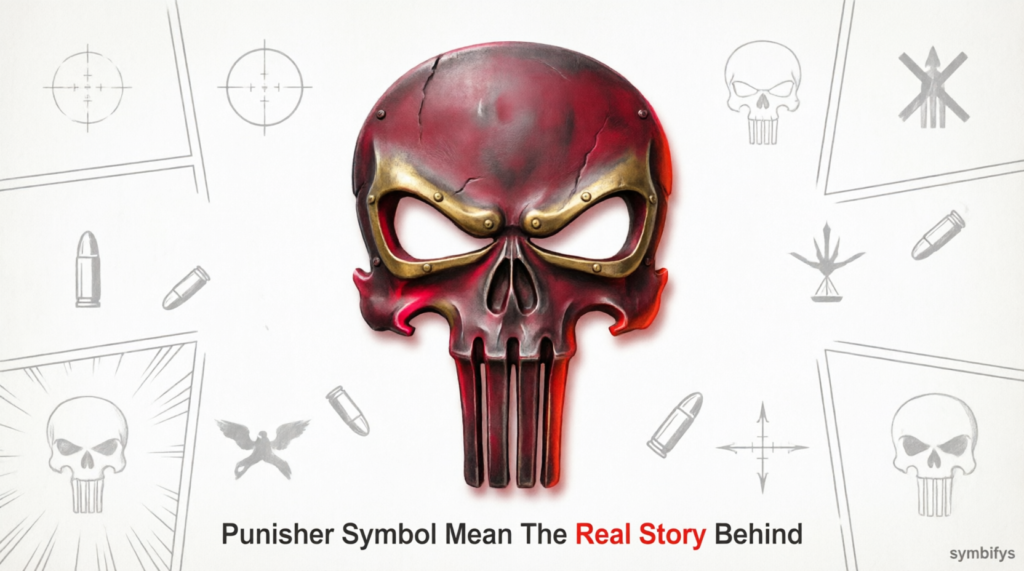
If you have ever seen the familiar white skull logo with elongated teeth and wondered, “What does the Punisher symbol mean?”, the short answer is: it represents the Punisher, Marvel’s vigilante character Frank Castle, and his uncompromising personal war against violent criminals.
But the symbol has become much bigger than a comic-book image.
Today, the Punisher skull appears on clothing, tattoos, stickers, vehicles, military gear, social-media profiles, and political imagery. Some people use it to represent toughness, resistance, or a refusal to back down. Others associate it with vigilantism, violence, aggressive policing, or far-right movements.
That makes the symbol unusually complicated.
Understanding it properly requires separating Marvel’s fictional meaning from the meanings people have attached to it in real life.
Marvel’s official character history describes Frank Castle as an ex-Marine whose family was killed by criminals, leading him to become the Punisher and wage a personal war on crime. His methods are deliberately extreme and exist outside normal legal justice.
So if you’ve seen the skull and wondered whether it simply means “justice,” the answer is more nuanced.
It represents punishment, vengeance, fear, resistance, and extrajudicial justice—depending heavily on who is using it and where you see it.
What Does the Punisher Symbol Mean – Quick Meaning
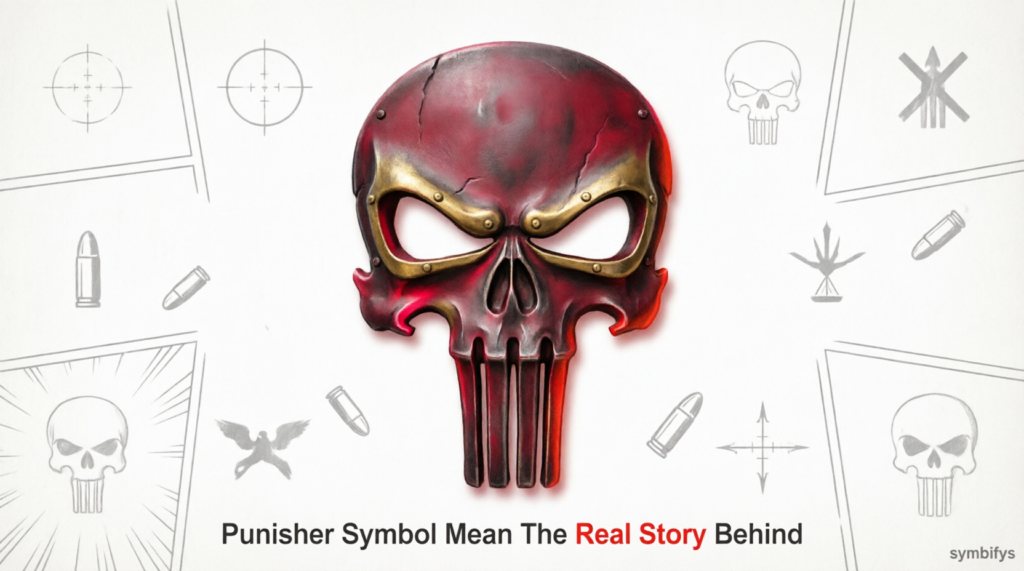
The Punisher symbol is the stylized skull associated with Frank Castle, the Marvel character known as the Punisher.
Its central ideas include:
- Punishment: The skull represents the Punisher’s mission to punish criminals.
- Vengeance: Frank Castle’s story begins with profound personal loss.
- Fear: Within the fictional story, the skull is intended to intimidate criminals.
- Vigilante justice: Castle operates outside the conventional legal system.
- Resistance: Some modern users interpret the skull as refusing to submit or back down.
- Aggression: In real-world settings, it can communicate a deliberately intimidating attitude.
Marvel describes Castle as an “instrument of justice” who conducts a one-man war against violent criminals. Ccdn.marvel.com
So someone might say:
“The Punisher skull represents Frank Castle.”
Or:
“He wears it because he likes the character.”
Another person might say:
“For me, the skull means standing up to people who abuse power.”
The symbol itself doesn’t automatically tell you which interpretation the wearer intends.
Context is everything.
Origin & Background
The Punisher was created during a very different era of American comic books.
Frank Castle first appeared in The Amazing Spider-Man #129, published in February 1974, written by Gerry Conway and penciled by Ross Andru. Marvel originally introduced him as a character hired by the Jackal to target Spider-Man.
He quickly developed into something much more interesting than a conventional villain.
Who is the Punisher?
Frank Castle is a former Marine whose family is murdered after they become caught in a violent criminal incident.
Rather than trusting the legal system to deliver justice, Castle becomes the Punisher.
He hunts criminals himself.
Marvel’s own character biography emphasizes that his methods are severe and often permanent, while his motivation is rooted in personal loss.
That distinction explains the skull.
It isn’t a traditional superhero emblem representing hope or protection.
It is closer to a warning.
The message is essentially:
You have been marked for punishment.
Why a skull?
The skull is an ancient visual symbol of mortality and death, so it immediately creates an emotional reaction.
But the Punisher skull is deliberately stylized.
Its exaggerated teeth and oversized shape make it highly recognizable even from a distance.
According to reporting on the character’s creation, Conway and artist Ross Andru initially imagined a smaller skull symbol, while Marvel art director John Romita helped develop the much larger skull design that became iconic. The Guardian
That visual decision mattered.
A small skull might have been a costume detail.
The enormous skull became the character’s identity.
Cultural influence
The Punisher emerged during a period when darker, morally complicated characters were becoming increasingly popular.
Unlike Superman, who represents an idealized form of heroism, Castle asks a more uncomfortable question:
What happens when someone stops believing the normal justice system is enough?
That question has kept the character relevant for decades.
Marvel has published numerous Punisher series, including The Punisher runs from different eras and the mature-reader Punisher MAX series. MMarvel+1
Military and police adoption
This is where the real-world story becomes complicated.
The skull was adopted by some military personnel and later appeared among some police officers and other groups.
One prominent example involved former Navy SEAL Chris Kyle, who described using the Punisher logo on equipment during his military service. The symbol subsequently became more visible among some police, militia, and far-right groups. The Guardian
That does not mean everyone who wears the skull supports those movements.
It does mean that the symbol has acquired associations beyond Marvel.
Social media impact
Social media has accelerated this evolution.
A person posting a Punisher skull may be expressing fandom.
Another may be signaling political identity.
Someone else may simply like the design.
And another person may see it as threatening.
That ambiguity is why the Punisher symbol deserves more contextual interpretation than many ordinary logos.
Real-Life Conversations
Person A:
Why does your cousin have that skull on his truck?
Person B:
The Punisher logo?
Person A:
Yeah. What does it actually mean?
Person B:
It’s from Marvel. It represents Frank Castle, the Punisher.
Person A:
So it’s not just a random skull?
Person B:
No. It’s specifically associated with his idea of taking justice into his own hands.
Instagram DMs
Person A:
Thinking about getting the Punisher skull tattoo.
Person B:
You know people interpret that symbol differently, right?
Person A:
Yeah, but I mostly like the character.
Person B:
That’s fair. Just remember some people associate it with aggressive policing too.
Person A:
Good point. I hadn’t thought about that side of it.
TikTok Comments
Person A:
Why do police use the Punisher logo?
Person B:
Some officers have used it as a symbol of toughness or a hard-line approach to crime.
Person A:
But isn’t Punisher literally a vigilante?
Person B:
Exactly. That’s why the symbolism has been controversial.
Person A:
So it’s kind of ironic?
Person B:
That’s one way people interpret it.
Text Messages
Person A:
I saw a guy wearing a Punisher shirt at the gym.
Person B:
Marvel fan?
Person A:
Maybe. I wasn’t sure if it meant something political.
Person B:
Could be either. The symbol has several modern associations.
Person A:
So you can’t really know without asking?
Person B:
Pretty much.
Emotional & Psychological Meaning
The Punisher skull carries a very different psychological message from symbols such as a heart, peace sign, or traditional superhero emblem.
It is designed to create tension.
A skull naturally reminds people of mortality.
The Punisher character adds another layer: someone is willing to cross boundaries to punish perceived wrongdoing.
That can make the symbol attractive to people who value strength, independence, resilience, or resistance.
For some fans, the skull represents the idea:
“I won’t be intimidated.”
For others, it means:
“Bad people deserve consequences.”
And for critics, it can suggest something much darker:
“Justice should be replaced by personal punishment.”
These interpretations can coexist.
That is one reason symbols are so psychologically interesting. People often choose an image because of one meaning while other observers read something completely different into it.
Imagine someone recovering from a difficult period who gets the Punisher skull tattoo.
They might not be celebrating violence at all.
They may see Frank Castle as a fictional representation of surviving unimaginable loss and refusing to collapse afterward.
That doesn’t erase the character’s violent nature, but it explains why a person might attach a deeply personal meaning to the symbol.
Usage in Different Contexts
Social Media
On Instagram, TikTok, Facebook, and X, the Punisher skull can mean several things.
It may indicate:
- Marvel fandom
- Interest in comics
- Toughness
- Military identity
- Anti-establishment attitudes
- Political views
- Personal resilience
- Aggressive or intimidating aesthetics
The surrounding profile usually provides important clues.
Friends & Relationships
Among friends, the symbol is often used casually.
Someone may wear a Punisher shirt simply because they enjoyed the comics, movies, or television series.
Friends who understand the character may recognize the reference immediately.
Work / Professional Settings
This is where caution becomes more important.
A Punisher symbol on a personal jacket is one thing.
A Punisher symbol displayed by someone in a position of institutional authority can communicate something very different.
The creator of the character, Gerry Conway, has specifically criticized the use of the skull by police because he viewed the Punisher as a vigilante who represents a failure of the justice system rather than lawful policing. The Guardian
That criticism is central to understanding the modern controversy.
Casual vs. Serious Tone
Among comic fans:
“Cool Punisher logo.”
may simply mean:
“I like Marvel.”
In a political or policing context, the exact same image can carry a much more serious message.
Never interpret the symbol without considering the setting.
When NOT to Use It
In Professional Authority Roles
If you represent a police department, security organization, school, government agency, or other institution, the Punisher skull can be interpreted as endorsing vigilantism.
That is especially important because the fictional character deliberately operates outside the law.
When You Don’t Understand Its Associations
If you’re considering using the symbol for a public campaign, business, uniform, or organization, understand that people may read more into it than “Marvel fan.”
Around Sensitive Political Situations
The skull has appeared alongside political and law-enforcement imagery, including “Blue Lives Matter” and other movements.
Some observers therefore interpret it as a political statement even when the wearer intended only a comic reference. The Guardian
With Children
The symbol isn’t inherently unsafe, but its connection with violence makes context important.
A Punisher shirt worn by a comic-book fan is different from teaching children that personal violence is a legitimate substitute for law and courts.
Don’t Assume Everyone Sees It as Harmless
If someone reacts negatively to the skull, that doesn’t necessarily mean they “don’t understand comics.”
They may be responding to its real-world political or policing associations.
Common Misunderstandings
“The Punisher skull simply means justice.”
Not exactly.
Frank Castle’s justice is vigilante justice, not ordinary legal justice.
“Anyone wearing it supports the far right.”
No.
The symbol has been used by comic fans, military personnel, police officers, political groups, activists, and people who simply like skull designs.
The context and individual matter.
“It’s just a skull.”
The design is much more specific than a generic skull.
The elongated teeth and distinctive shape identify the Punisher character.
“Punisher is a normal superhero.”
Not really.
He is generally categorized as an antihero or vigilante, and his willingness to kill distinguishes him sharply from many conventional Marvel heroes.
“The skull was originally a political symbol.”
No.
It originated as the emblem of a fictional Marvel character in the 1970s. Its political and institutional associations developed later.
“The symbol has one universal meaning.”
Definitely not.
Its meaning depends heavily on whether it appears in a comic store, on a motorcycle, in a tattoo, on military equipment, at a political demonstration, or on a police uniform.
Comparison Table
| Symbol / expression | Main meaning | Typical association |
|---|---|---|
| Punisher skull | Punishment, vengeance, vigilante justice | Marvel, toughness, resistance |
| Generic skull | Mortality, danger, rebellion | Broad cultural use |
| Skull and crossbones | Danger, death, poison, piracy | Safety symbols, piracy |
| Superhero emblem | Hero identity and ideals | Comic-book culture |
| “No mercy” | Refusal to show leniency | Aggressive rhetoric |
| “Justice” | Fairness under a moral/legal system | Law, ethics |
| “Vengeance” | Retaliation for perceived wrongdoing | Personal revenge |
| “Resist” | Opposition or defiance | Political/social movements |
| Police badge | Lawful authority and public service | Law enforcement |
| Thin blue line | Support for law enforcement | Police culture and politics |
Key Insight
The Punisher skull does not have one fixed real-world meaning. Its original meaning comes from Marvel’s fictional vigilante, while modern users have added associations involving military culture, policing, politics, resistance, and personal toughness.
Variations / Types
1. Classic Punisher Skull
The traditional elongated white skull associated with Frank Castle.
This is the version most people recognize immediately.
2. Black-and-White Punisher Logo
A high-contrast treatment commonly used on clothing and merchandise.
Its stark appearance reinforces the character’s darker identity.
3. Stylized Punisher Skull
Artists frequently modify the teeth, proportions, shading, or surrounding elements.
The more stylized it becomes, the more it may function as general skull artwork rather than an exact Marvel reference.
4. Military Punisher Skull
Versions associated with military culture have appeared on equipment, clothing, and artwork.
These uses helped move the symbol beyond comic books.
5. Police-Associated Punisher Skull
Some officers and police communities have used the emblem to communicate toughness or a hard-line attitude.
This is one of the most controversial modern uses.
6. Political Punisher Skull
The symbol can appear alongside political slogans or imagery.
At that point, its meaning becomes inseparable from the surrounding political message.
7. Punisher Tattoo
People may choose the skull as a permanent symbol of resilience, anger, survival, fandom, or toughness.
The wearer’s personal explanation matters more than assumptions.
8. Punisher Motorcycle Decal
The skull is popular in motorcycle and automotive customization.
Here, it can function primarily as an aggressive visual identity.
9. Punisher Clothing
T-shirts, jackets, hats, and patches often use the skull as a recognizable pop-culture reference.
10. Modified Punisher Skull
Some designs combine the skull with flags, slogans, crosses, weapons, or other symbols.
These additions can dramatically change what the overall image communicates.
How to Respond When Someone Uses It
Casual Replies
- “That’s the Punisher skull from Marvel.”
- “It’s Frank Castle’s symbol.”
- “Classic Punisher logo.”
Funny Replies
- “That’s one seriously judgmental skull.”
- “Marvel’s least subtle warning sign.”
- “When a skull needs to make a statement.”
Mature Replies
- “It’s the emblem of Frank Castle, a Marvel vigilante whose approach to justice is intentionally extreme.”
Respectful Replies
- “It can mean different things depending on context. Originally, it’s the symbol of Marvel’s Punisher character, but it has acquired additional real-world associations.”
That last answer is often the safest because it avoids assuming someone’s political beliefs from an image alone.
Regional & Cultural Usage
Western Culture
In the United States and Canada, the Punisher is deeply established in comic-book and superhero culture.
The symbol is also connected with military, police, motorcycle, political, and alternative fashion communities.
Those overlapping uses make its interpretation highly context-dependent.
Asian Culture
Across Asian markets, the skull is often encountered primarily through global Marvel fandom.
A person may recognize it as a comic-book symbol without knowing the political controversy surrounding some American uses.
Middle Eastern Culture
The symbol may similarly be understood through global entertainment, gaming, comics, military imagery, and social media.
Local interpretations can differ considerably from American political associations.
Global Internet Usage
Online culture has turned the Punisher skull into a kind of visual shorthand.
Someone can use it to say:
“I’m a Punisher fan.”
or:
“I’m tough.”
or:
“I reject conventional authority.”
The surrounding content determines which interpretation is most plausible.
Gen Z vs. Millennials
Millennials who grew up with 1990s and 2000s Marvel comics may see the skull primarily as a nostalgic pop-culture reference.
Gen Z may associate it with Marvel films, streaming adaptations, memes, gaming, tattoos, and political internet culture.
The character’s core identity remains recognizable, but the cultural baggage around the symbol has expanded.
Is It Safe for Kids?
The Punisher symbol is not inherently dangerous, but it represents a character and fictional world built around violence, revenge, and vigilantism.
For younger children, the important issue is context.
A child seeing the skull on a comic-book shirt is different from a child being taught that the Punisher’s methods are an appropriate model for solving real-world conflicts.
Parents can explain the symbol simply:
“That’s a comic-book character who fights criminals in a very extreme way.”
Older children can explore the more interesting question behind the character: Is revenge the same thing as justice?
That question is far more educational than simply memorizing the logo’s name.
FAQs
What does the Punisher symbol mean?
The Punisher skull represents Frank Castle, Marvel’s vigilante character, and is associated with punishment, vengeance, and his personal approach to justice.
Why does the Punisher have a skull?
The skull acts as a threatening emblem for Frank Castle. It symbolizes death, fear, punishment, and his identity as the Punisher.
Is the Punisher symbol a hate symbol?
The skull itself originated as a Marvel character emblem and is not inherently a hate symbol. However, some extremist and far-right groups have used it, giving the symbol additional associations in certain contexts. The
Why do police use the Punisher skull?
Some police officers have used it to express toughness or a hard-line attitude toward crime. Critics, including Punisher co-creator Gerry Conway, argue that this is inconsistent with a character who operates outside the law.
Is the Punisher a hero or a villain?
The Punisher is generally considered an antihero or vigilante. He sometimes works alongside conventional heroes, but his methods are far more extreme than those of most Marvel superheroes.
When did the Punisher first appear?
The Punisher first appeared in The Amazing Spider-Man #129, published in February 1974.
Can the Punisher skull mean something positive?
Yes. Some people use it to represent resilience, survival, resistance, strength, or admiration for the fictional character. The meaning depends heavily on the person and context.
Conclusion
So, what does the Punisher symbol mean?
Originally, the skull is the unmistakable emblem of Frank Castle, Marvel’s Punisher—a vigilante whose life is shaped by tragedy and whose idea of justice exists outside the normal legal system. He is driven by punishment and vengeance rather than conventional superhero ideals.
That is the historical starting point.
But the story does not end there.
The skull has escaped the pages of comic books and acquired additional meanings through military culture, policing, politics, activism, fashion, tattoos, and internet communities. Some people see courage and resistance. Others see aggression or vigilantism. Some simply see a favorite Marvel character.
That is why you should never decide what someone believes simply because you see the Punisher skull.
A symbol communicates—but people communicate through symbols in very different ways.
The most accurate interpretation is therefore also the most human one:
The Punisher skull represents punishment and uncompromising justice in its original fictional context, but its real-world meaning depends on who is using it, where it appears, and what surrounds it.
And perhaps that complexity is exactly why the symbol has remained so recognizable after more than five decades.
descover more post
What Does the Triangle Symbol With an Exclamation Point …
What Does This Chinese Symbol Mean A Complete Guide …
What Does the Car Symbol With an Arrow Mean A …

Klevin is a language and digital content writer with over 6 years of experience creating engaging, reader-focused articles. As a contributor at Symbifys.com, he specializes in explaining internet slang, text abbreviations, symbols, emojis, and modern communication trends in a clear and easy-to-understand way. His writing combines thorough research with practical examples, helping readers quickly find accurate answers. Klevin is committed to producing trustworthy, SEO-friendly content that is both informative and enjoyable to read. His goal is to make complex topics simple, useful, and accessible for every visitor.