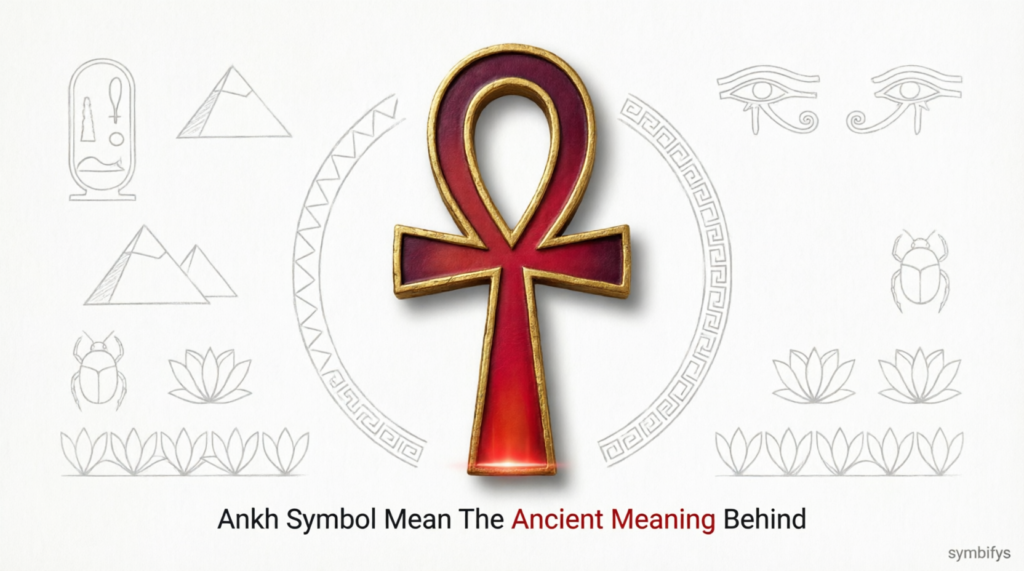
If you have ever seen a cross-shaped symbol with a loop at the top and wondered, “What is the ankh symbol mean?”, you are looking at one of ancient Egypt’s most recognizable symbols.
The ankh is an ancient Egyptian hieroglyph traditionally associated with life, living, vitality, and the continuation of life. Its distinctive shape a loop above a cross-like form appears frequently in ancient Egyptian art, especially in the hands of gods and goddesses.
People often search for the ankh’s meaning because its appearance is simple but mysterious. Is it a religious symbol? Does the loop represent something specific? Is it connected with death, immortality, or protection?
The answer is more interesting than a single definition.
The ankh was closely connected with life, but ancient Egyptian ideas about life were much broader than simply being alive. The symbol could appear in scenes involving divine power, kingship, offerings, temples, and the afterlife.
Today, the ankh has also taken on new meanings in jewelry, fashion, tattoos, music, popular culture, and social media. Understanding those modern uses requires separating ancient Egyptian symbolism from later interpretations.
What Is the Ankh Symbol Mean – Quick Meaning
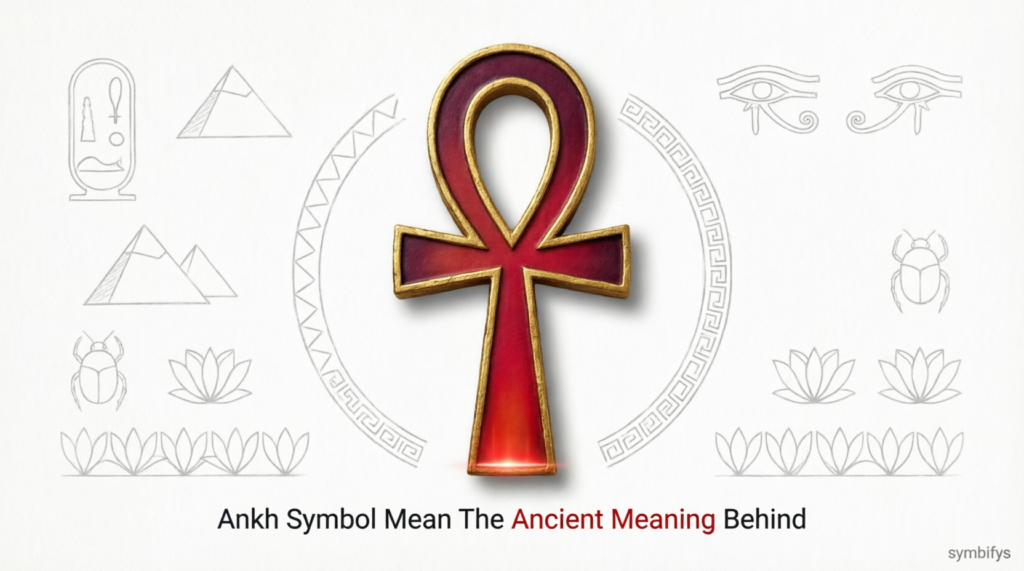
The ankh (☥) is an ancient Egyptian symbol associated primarily with life.
It is sometimes called the “key of life” or “key of the Nile,” although these names are modern descriptive labels rather than straightforward ancient Egyptian names. The Egyptian hieroglyph itself represented the concept of life.
In simple terms:
- ☥ = ankh
- Primary meaning = life
- Ancient Egyptian context = life, vitality, and divine life
- Modern associations = life, immortality, spirituality, protection, and Egyptian heritage
You might hear someone say:
“The ankh represents life.”
Or:
“She wears an ankh necklace for its Egyptian symbolism.”
Another common statement is:
“The ankh is an ancient Egyptian symbol of eternal life.”
That last phrase captures an important modern interpretation, but it is worth remembering that ancient Egyptian beliefs about life and the afterlife were complex.
The safest historical explanation is that the ankh is fundamentally a sign for life.
Origin & Background
The ankh comes from ancient Egypt, where hieroglyphic writing combined written language with visually meaningful signs.
The ankh’s hieroglyphic form resembles a cross with a loop at the top. In Egyptian writing, it represented the word and concept of life. The Metropolitan Museum of Art describes the ankh as a hieroglyph meaning “life” and notes its frequent appearance in Egyptian art.
Where did the shape come from?
This is where things become less certain.
You will find many explanations online claiming that the loop represents the sun rising over the horizon, the female reproductive organs, a sandal strap, or other symbolic ideas.
Some of these interpretations have been discussed by scholars, but there is no universally accepted explanation proving exactly why the hieroglyph has that particular shape.
That distinction matters.
We can confidently say what the hieroglyph represented—life—without pretending that its visual origin is completely understood.
The ankh in ancient Egyptian art
The symbol appears throughout Egyptian religious and royal imagery.
Gods and goddesses are frequently shown holding ankh symbols. In some scenes, deities extend ankhs toward the nose or mouth of a king, symbolically connecting him with life or divine vitality.
This gives the symbol an important dimension.
The ankh was not merely a decorative cross.
Within religious imagery, it could communicate the divine granting or sustaining of life.
Life and the afterlife
Ancient Egyptian culture did not treat earthly life and the afterlife as completely separate ideas.
The preservation of the body, funerary rituals, tombs, offerings, and religious texts all reflected an elaborate understanding of continued existence after death.
As a result, the ankh naturally became associated in later interpretation with ideas such as eternal life and immortality.
But it is useful to avoid reducing Egyptian religion to the simple phrase “the symbol of immortality.”
Its primary hieroglyphic meaning was life, while its religious context could extend that concept into ideas about divine and continuing existence.
Cultural influence
The ankh has survived long after ancient Egyptian civilization.
It has appeared in museums, books, archaeological illustrations, jewelry, artwork, tattoos, clothing, films, music, and contemporary spiritual communities.
Its modern popularity partly comes from the remarkable visual simplicity of the symbol.
You can recognize ☥ instantly.
That makes it especially powerful as a modern emblem.
Social media impact
On Instagram, TikTok, Pinterest, and other platforms, the ankh is often presented as a symbol of:
- Life
- Spirituality
- Egyptian heritage
- Protection
- Eternal existence
- Personal transformation
Some of these meanings are historically grounded; others are modern interpretations.
That distinction is worth keeping in mind when reading viral posts about the symbol.
Real-Life Conversations
Person A:
What does this ☥ symbol mean?
Person B:
That’s an ankh. It’s an ancient Egyptian symbol for life.
Person A:
Is it religious?
Person B:
It was strongly connected with ancient Egyptian religion, especially divine life and vitality.
Person A:
So it’s more than just an Egyptian-looking cross?
Person B:
Definitely. The symbolism goes much deeper.
Instagram DMs
Person A:
Thinking about getting an ankh tattoo.
Person B:
Nice. Do you know what it means?
Person A:
Life, right?
Person B:
Yes, that’s the basic ancient Egyptian meaning. It can also carry modern ideas about spirituality and eternal life.
Person A:
That’s exactly why I like it.
TikTok Comments
Person A:
Why does everyone say the ankh means eternal life?
Person B:
It’s primarily the ancient Egyptian hieroglyph for “life.”
Person A:
So eternal life isn’t technically the whole definition?
Person B:
Right. That’s more of a broader religious interpretation.
Person A:
That actually makes more sense.
Text Messages
Person A:
Grandma gave me an ankh necklace.
Person B:
That’s beautiful. ☥
Person A:
I looked it up. Apparently it means life.
Person B:
Yeah. Ancient Egyptian symbol.
Person A:
I think that’s why she chose it. She always says life is the greatest gift.
Person B:
Then it sounds like the symbol has a pretty meaningful story behind it.
Emotional & Psychological Meaning
The ankh has an unusually positive central idea: life.
That gives it emotional flexibility.
Someone may wear an ankh because they value life. Another person may see it as a reminder to keep moving forward after a difficult period. Someone else may connect it with spirituality, ancestry, Egyptian history, or personal identity.
The psychological attraction is easy to understand.
A symbol that represents life itself can become a compact reminder of something deeply personal.
Imagine someone going through a major transition—a new career, recovery from a difficult period, or simply a stage of growing older.
They may choose an ankh necklace not because they believe every historical interpretation attached to it, but because the symbol reminds them:
“I am here. I am alive. Life continues.”
That is how symbols often work in real communication.
Their historical meaning provides the foundation, but personal experience gives the symbol emotional depth.
Usage in Different Contexts
Social Media
Online, the ankh is frequently used in posts about:
- Ancient Egypt
- Egyptian mythology
- Spirituality
- Jewelry
- Tattoos
- History
- African and Egyptian cultural identity
- Personal transformation
Its visual simplicity also makes it popular in usernames, artwork, graphics, and profile imagery.
Friends & Relationships
Someone might give an ankh necklace to a friend or partner as a symbolic gift.
In modern contexts, it can communicate ideas such as:
“Life is precious.”
or:
“I want you to keep living fully.”
However, the personal meaning should not automatically be presented as the exact ancient Egyptian interpretation.
Work / Professional Settings
The ankh is appropriate in educational, historical, archaeological, museum, and cultural contexts.
For example, a museum educator might use it when discussing Egyptian hieroglyphs.
In professional branding, however, context matters. A business should understand the symbol’s cultural and religious associations before using it simply because it “looks Egyptian.”
Casual vs. Serious Tone
In casual conversation, calling it an Egyptian life symbol is understandable.
In serious historical writing, ankh or ancient Egyptian hieroglyph for life is more accurate.
The more scholarly the context, the more important it becomes to distinguish documented history from modern symbolism.
When NOT to Use It
Don’t Claim Every Modern Meaning Is Ancient
You may see claims that the ankh specifically means “male and female unity,” “sexual balance,” “the key to heaven,” or other highly specific concepts.
Some are modern interpretations rather than established translations of the ancient hieroglyph.
Don’t Treat It as a Generic Cross
Although it looks cross-shaped, the ankh belongs to a very different historical and cultural tradition.
Calling it simply an “Egyptian cross” can hide its specific meaning and history.
Be Careful With Religious Context
The ankh has genuine connections to ancient Egyptian religious traditions.
If you use it in a modern spiritual or religious setting, understand that your interpretation may differ from its original historical context.
Don’t Use It to Impersonate Cultural Identity
A symbol can be appreciated without claiming an identity or heritage you do not have.
Cultural appreciation becomes more respectful when it includes some understanding of historical context.
Common Misunderstandings
“The ankh means death.”
No.
Its primary hieroglyphic meaning is life, not death.
Its appearance in funerary and afterlife contexts can create confusion, but that reflects ancient Egyptian beliefs about continued existence.
“The ankh definitely means eternal life.”
That is a common modern description, but the more precise basic meaning is life.
“Eternal life” describes a broader religious interpretation rather than replacing the hieroglyph’s fundamental meaning.
“The loop has one proven meaning.”
Not necessarily.
The exact origin of the ankh’s visual form remains debated.
“The ankh is just a fashion symbol.”
It can certainly be used as a fashion symbol today, but it has a long historical and religious background.
“It is the same as a Christian cross.”
No.
The shapes are visually related only in the broad sense that both have cross-like structures.
Their historical origins and religious meanings are different.
“Anyone who wears an ankh follows ancient Egyptian religion.”
Not at all.
Modern people wear ankhs for many reasons, including fashion, historical interest, spirituality, cultural appreciation, and personal symbolism.
Comparison Table
| Symbol or expression | Main meaning | Historical context |
|---|---|---|
| ☥ Ankh | Life | Ancient Egypt |
| Cross (✝) | Christian faith, sacrifice, resurrection | Christianity |
| Eye of Horus | Protection, well-being, restoration | Ancient Egypt |
| Scarab | Renewal, transformation, regeneration | Ancient Egypt |
| Djed | Stability and enduring order | Ancient Egypt |
| Was scepter | Power, authority, dominion | Ancient Egypt |
| Caduceus | Traditionally linked to Hermes; often used incorrectly as a medical symbol | Ancient Greece/Rome and later usage |
| Yin-yang | Complementary forces and balance | Chinese philosophy |
| Infinity symbol (∞) | Endless continuation | Modern mathematical and symbolic usage |
| Life symbol | Broadly represents vitality or existence | Modern/general usage |
Key Insight
The ankh’s most firmly established meaning is life. Ideas such as immortality, protection, spirituality, and eternal existence are broader associations that developed through religious context and modern interpretation.
Variations / Types
The ankh itself is a specific ancient Egyptian hieroglyph, but its appearance and modern use have produced many recognizable variations.
1. Traditional Ankh
The classic ☥ shape with a loop above a cross-like base.
This is the form most closely associated with ancient Egyptian writing and art.
2. Hieroglyphic Ankh
The ankh used specifically as an Egyptian hieroglyph.
Its fundamental meaning is life.
3. Ankh in Religious Art
Gods and goddesses are often depicted holding the ankh.
This emphasizes the connection between divine power and life.
4. Ankh Necklace
A common modern jewelry form.
People may wear it for its historical symbolism, spirituality, fashion, or personal meaning.
5. Ankh Pendant
Similar to a necklace but often referring specifically to the decorative central piece.
It has become a recognizable fashion accessory.
6. Ankh Tattoo
Modern tattoos frequently use the symbol as a permanent reminder of life, identity, spirituality, or Egyptian history.
The meaning is personal and does not necessarily reproduce ancient Egyptian beliefs exactly.
7. Ankh With Wings
A modern artistic variation incorporating wings.
It should not automatically be treated as an ancient Egyptian design.
8. Ankh With Eye Motifs
Some contemporary designs combine the ankh with the Eye of Horus.
This creates a broader Egyptian-inspired visual composition.
9. Decorative Ankh
Used in artwork, home decoration, clothing, or graphic design.
Its meaning may be primarily aesthetic or symbolic.
10. Digital Ankh
The Unicode character ☥ allows the symbol to be used in modern digital communication.
It can appear in usernames, captions, messages, and educational content.
How to Respond When Someone Uses It
Casual Replies
- “That’s an ankh. It represents life.”
- “It’s an ancient Egyptian symbol for life.”
- “The symbol is called an ankh.”
Funny Replies
- “Ancient Egypt had some seriously memorable symbols.”
- “☥ One tiny symbol, thousands of years of history.”
- “It’s basically the ancient Egyptian symbol everyone recognizes.”
Mature Replies
- “The ankh is an ancient Egyptian hieroglyph meaning life. Its religious context also connects it with divine and continuing life.”
Respectful Replies
- “The ankh has deep roots in ancient Egyptian culture, where it represented life.”
- “Its modern meanings vary, but its historical foundation is the Egyptian concept of life.”
Regional & Cultural Usage
Western Culture
In Western popular culture, the ankh is frequently associated with ancient Egypt, spirituality, mysticism, jewelry, and alternative fashion.
Its meaning has expanded considerably beyond its original hieroglyphic function.
Asian Culture
Across Asian cultures, the ankh may be encountered primarily through global popular culture, history education, museums, fashion, or spiritual communities.
It does not have a single universal interpretation across Asian societies.
Middle Eastern Culture
Because ancient Egypt is part of the broader history of the Middle East and North Africa, the ankh can carry particularly strong historical associations in the region.
Modern interpretations still vary from person to person.
Global Internet Usage
Online, the ankh often becomes shorthand for life, spirituality, Egyptian heritage, or ancient wisdom.
However, viral explanations should be treated carefully. Internet popularity does not automatically make an interpretation historically accurate.
Gen Z vs. Millennials
Gen Z may encounter the ankh through tattoos, jewelry, fashion, TikTok, gaming, music, and aesthetic content.
Millennials may have encountered it more often through history documentaries, museum exhibitions, films, books, or alternative music and fashion culture.
Both generations can attach modern personal meanings to the symbol while recognizing its ancient Egyptian roots.
Is It Safe for Kids?
Yes. The ankh is a historical cultural symbol and is generally safe for children to encounter.
It can actually provide an excellent introduction to ancient Egyptian history, hieroglyphs, religion, and symbolism.
For younger children, it is best to explain the symbol simply:
“The ankh is an ancient Egyptian sign that means life.”
Older children can then learn how the symbol appeared in religious art and how its meaning has been interpreted over time.
FAQs
What does the ankh symbol mean?
The ankh is an ancient Egyptian hieroglyph that primarily means life. It is also associated with vitality and, in broader religious contexts, continued or eternal life.
What is the ankh symbol used for?
Historically, the ankh was used as a hieroglyph meaning life and appeared extensively in Egyptian religious and royal art.
Is the ankh a religious symbol?
Yes, it has important connections with ancient Egyptian religion, where gods and goddesses were frequently shown holding or presenting the ankh.
Does the ankh mean eternal life?
The ankh primarily means life. Its association with eternal or continuing life comes from the broader religious context of ancient Egyptian beliefs.
What does ☥ stand for?
The character ☥ represents the ankh, the ancient Egyptian hieroglyph associated with life.
Is the ankh a cross?
It is cross-shaped, but it is not a Christian cross. The ankh comes from ancient Egyptian writing and religious culture.
Why do people wear ankh necklaces?
People wear ankh jewelry for many reasons, including interest in Egyptian history, spirituality, fashion, cultural appreciation, or the personal idea of celebrating life.
Conclusion
So, what does the ankh symbol mean?
At its heart, the answer is wonderfully simple: the ankh means life.
It began as an ancient Egyptian hieroglyph and became deeply woven into Egyptian religious and artistic imagery. Gods and goddesses could be shown holding it, emphasizing the connection between divine power and life.
Over thousands of years, the symbol has traveled far beyond the walls of Egyptian temples and tombs.
Today, someone might wear an ankh as jewelry, choose it for a tattoo, use ☥ in a social-media profile, or simply admire it as one of history’s most recognizable symbols.
Those modern meanings can be personal.
The important thing is to understand the historical foundation before adding your own interpretation.
The ankh is not merely an exotic-looking shape. It is a visual expression of one of humanity’s oldest and most universal ideas: the value, mystery, and continuity of life.
And perhaps that is why a symbol created thousands of years ago can still feel meaningful today.
descover more post
What Does a Diamond Symbol Mean on Jewelry 2026
What Does Prince’s Symbol Mean The Story Behind …
What Does the Butterfly Symbol Mean 12 Powerful …

Mia Enderson is a dedicated content writer and digital research specialist with over 7 years of experience creating insightful and reader-focused content. She specializes in technology, business, and online trends, delivering well-researched and engaging articles. At Symbifys.com, Mia is committed to providing accurate, valuable, and easy-to-understand information that helps readers make informed decisions. Her passion for quality content and attention to detail have earned the trust of a growing audience.