If you have ever seen a Chinese symbol on a tattoo, necklace, piece of clothing, restaurant sign, phone wallpaper, artwork, or social-media post and wondered, “What does this Chinese symbol mean?”, you are certainly not alone.
Chinese characters can look mysterious when you do not read Chinese. A single character may contain several strokes that seem decorative to an English-speaking reader, yet those strokes can represent a word, concept, sound, or part of a larger expression.
The important thing to understand is that there is no single meaning for “a Chinese symbol.” You need to identify the actual character before translating it accurately.
Chinese writing uses characters rather than an alphabet like English. Individual characters can have meanings of their own, while multiple characters can combine to form words and phrases. Chinese dictionaries also distinguish between character-level information and complete-word meanings.
This matters because a character that looks beautiful may not mean what someone on social media claims it means.
A tattoo advertised as “strength,” for example, might actually represent a different word or an unusual interpretation. Similarly, a character associated online with “love,” “luck,” or “peace” may have a more specific meaning when placed inside a complete Chinese phrase.
So, what does this Chinese symbol mean?
The answer begins with identifying the character, understanding its pronunciation, examining its context, and then looking at its cultural or historical associations.
What Does This Chinese Symbol Mean? – Quick Meaning
A Chinese symbol is often actually a Chinese character (汉字, hànzì).
Chinese characters are written units that can represent meanings and sounds. Some characters can function as words by themselves, while others are commonly used together with additional characters.
For example:
- 爱 (ài) — love
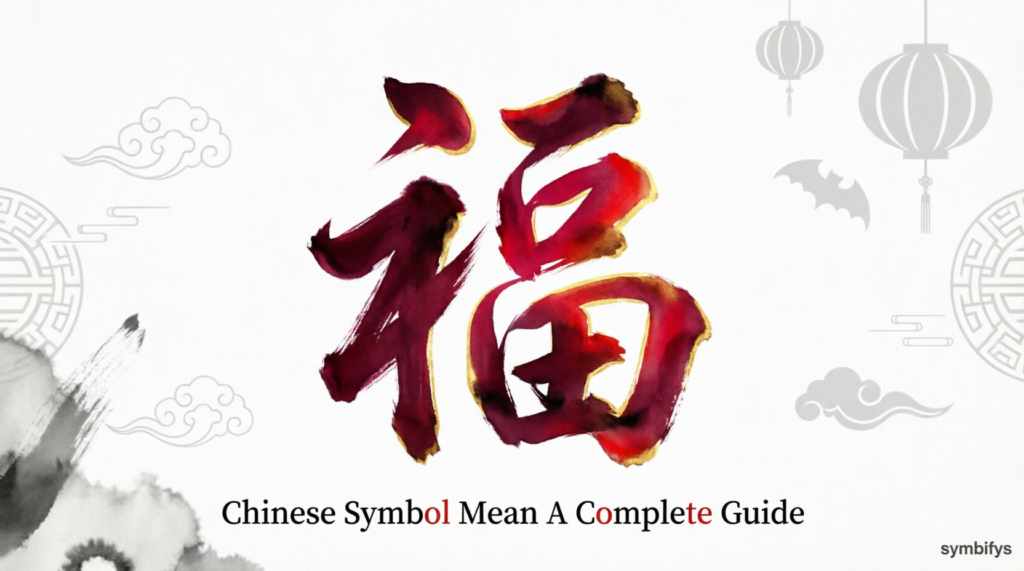
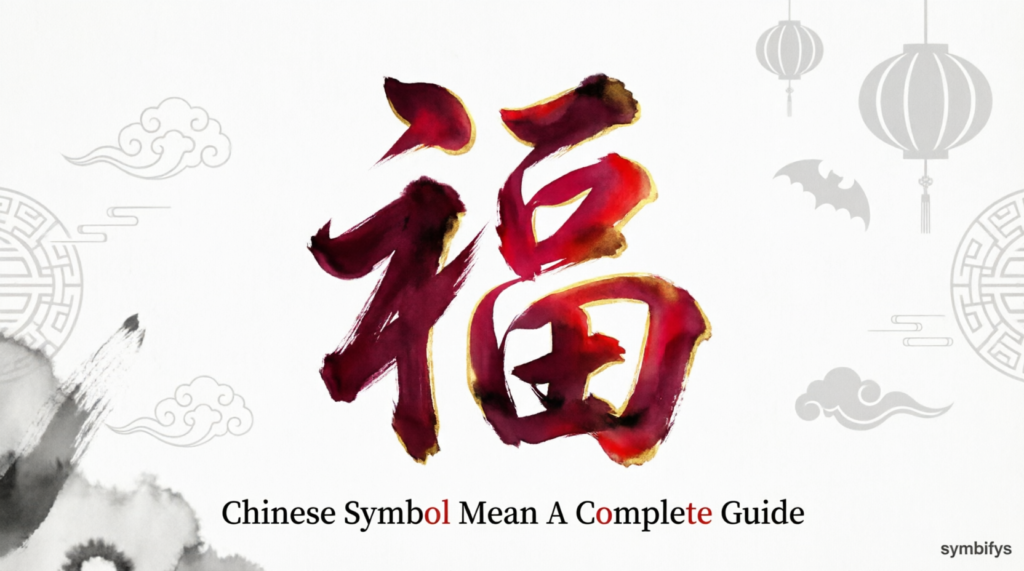
- 福 (fú) — good fortune or blessing
- 和 (hé) — harmony, peace, or togetherness depending on context
- 龙 / 龍 (lóng) — dragon
- 寿 / 壽 (shòu) — longevity
You might see someone say:
“This Chinese symbol means love.”
That could refer to 爱, but without seeing the actual character, there is no way to know for certain.
Another person might say:
“This symbol means good luck.”
They could be referring to 福, 吉, or another character associated with positive fortune.
And someone might simply call a character a “symbol” because they do not know the linguistic term character.
That distinction is worth remembering.
A character has a linguistic meaning; a symbol can also carry cultural, artistic, religious, or personal symbolism.
Origin & Background of Chinese Characters
Chinese characters have a very long history. Early forms were used thousands of years ago, and their shapes developed through different stages of Chinese writing.
Some early characters were pictographic, meaning their forms were connected to pictures or visual representations of objects. Others developed through combinations of components or through relationships between sound and meaning.
Traditional Chinese character analysis has historically classified characters into several formation and usage categories. These include pictographic, indicative, associative-compound, pictophonetic, and other classifications.
A useful example is 中, pronounced zhōng in Mandarin in one common reading. Its meanings include “middle,” “center,” and “central.” Its traditional etymological explanation connects its form with an object or marker at the center.
Over time, Chinese writing also developed different styles, including forms used in inscriptions, formal writing, calligraphy, and everyday handwriting.
Modern Chinese primarily uses two major written forms:
- Simplified Chinese
- Traditional Chinese
They are closely related, but some characters have different written forms.
For example:
国 is the simplified form.
國 is the traditional form.
The underlying meaning is the same: country, nation, or state.
Chinese characters also spread beyond mainland China and remain important in Chinese-speaking communities around the world. Related character traditions have also influenced writing systems and vocabulary in other East Asian cultures.
Social Media and the Modern Meaning of Chinese Characters
Social media has changed how people encounter Chinese characters.
A character might appear in a tattoo video, motivational quote, fashion design, gaming username, decorative poster, or viral image.
Unfortunately, internet explanations are not always accurate.
A visually attractive character can be copied thousands of times even when its translation is incomplete or incorrect. That is why identifying the actual character is more reliable than guessing from its appearance.
Modern digital dictionaries can search Chinese by written character, pinyin, English meaning, components, or even handwriting. Handwriting recognition is especially useful when you can see a character but cannot type it.
Real-Life Conversations
Person A:
What does this Chinese symbol mean? I found it on Pinterest.
Person B:
Send me a clearer picture.
Person A:
Here.
Person B:
It looks like a Chinese character, but I’d want to identify the exact character before translating it.
Person A:
So you can’t just tell from the shape?
Person B:
Sometimes you can recognize it, but guessing can give you the wrong meaning.
Instagram DMs
Person A:
I want this symbol tattooed. It means “strength,” right?
Person B:
I’m not sure. Where did you get the translation?
Person A:
A random Instagram page.
Person B:
I’d verify it with a reliable Chinese dictionary first. Tattoos are permanent.
TikTok Comments
Person A:
Does this Chinese symbol mean luck?
Person B:
It might be 福, which is associated with good fortune and blessings.
Person A:
Oh, so the exact character matters?
Person B:
Exactly. Different characters can look similar to someone who doesn’t read Chinese.
Text Messages
Person A:
What does this character mean? 中
Person B:
It commonly relates to “middle,” “center,” or “central,” and it can have other uses depending on context.
Person A:
So one character can have more than one meaning?
Person B:
Yes. Context is really important in Chinese.
Emotional & Psychological Meaning
Chinese characters can carry emotional weight far beyond their dictionary definitions.
A character associated with love, family, peace, fortune, courage, longevity, or harmony may be chosen because of what the concept represents emotionally.
This is particularly noticeable in tattoos and decorative artwork.
Someone may choose a Chinese character not because they speak Chinese fluently, but because the concept behind it represents an important moment in their life.
A person recovering from a difficult period might choose a character associated with strength.
Someone celebrating a relationship might choose a character connected with love.
Another person may choose a character representing peace because they want a daily reminder to remain calm.
The emotional meaning comes from the person’s relationship with the concept, not necessarily from the character itself.
Imagine someone wearing a necklace featuring a character they believe means “hope.” Every time they touch it, they remember a difficult period they survived.
The character has now become personally meaningful.
But that personal symbolism should not be confused with the literal Chinese definition.
That distinction is important when discussing cultural symbols respectfully.
Usage in Different Contexts
Social Media
On social media, Chinese characters are often used aesthetically.
They may appear in captions, usernames, tattoos, wallpapers, graphic designs, and motivational posts.
The character may be used for its literal meaning, cultural association, visual appearance, or all three.
Friends and Relationships
Couples sometimes choose Chinese characters connected with love, loyalty, harmony, destiny, or family.
However, a character should be checked carefully before being used as a permanent romantic symbol.
A translation that sounds poetic in English may not have exactly the same emotional meaning in Chinese.
Work and Professional Settings
Chinese characters can appear in business names, logos, restaurant signs, product packaging, and international branding.
In professional contexts, accuracy matters.
A company should not assume that translating an English word into one Chinese character will automatically create a natural Chinese brand name.
Chinese words often depend on combinations of characters and cultural associations.
Casual vs. Serious Tone
A character printed on a T-shirt may simply be decorative.
The same character carved into a monument may carry historical, spiritual, or ceremonial significance.
Context changes interpretation.
When NOT to Use It
Be especially careful when you do not know the exact meaning of a Chinese character.
Avoid Guessing
Do not assume a character means something simply because it looks similar to another character.
Chinese contains many characters with visually related components.
Avoid Unverified Tattoo Translations
This is one of the most important practical rules.
If you are considering a permanent tattoo, verify the exact character, pronunciation, meaning, and cultural appropriateness first.
Avoid Treating All Chinese Characters as Symbols
Chinese characters are part of a living writing system.
Calling every character a mystical “symbol” can oversimplify the language and culture.
Avoid Cultural Stereotypes
A Chinese character does not automatically represent “ancient wisdom,” spirituality, mystery, or martial arts.
Those associations are often created by Western popular culture rather than by the character itself.
Common Misunderstandings
“Every Chinese character has only one meaning.”
Not necessarily.
A character may have several related meanings, pronunciations, or grammatical functions.
“One character always equals one English word.”
Not always.
Chinese words can consist of one character, but many common words contain two or more characters.
“If I know the English translation, I know the cultural meaning.”
Not necessarily.
A dictionary definition gives you an important starting point, but cultural associations can be broader or more specific.
“Traditional and simplified characters mean different things.”
Usually not.
In many cases, simplified and traditional forms represent the same underlying character and meaning, although their written forms differ.
“A beautiful-looking character must have a beautiful meaning.”
Definitely not.
This is one of the biggest traps when choosing Chinese characters for artwork or tattoos.
Appearance and meaning are separate things.
Comparison Table
| Term | Meaning | Example |
|---|---|---|
| Chinese character | A written unit in Chinese | 爱 |
| Chinese word | One or more characters forming a lexical unit | 朋友 |
| Chinese symbol | Informal term for a character or culturally meaningful image | A character used decoratively |
| Pinyin | Romanized representation of Mandarin pronunciation | ài |
| Radical | A traditional indexing component of a character | 氵 in many water-related characters |
| Calligraphy | Artistic writing of characters | Brush-written Chinese |
| Simplified character | Modern simplified written form used mainly in mainland China and Singapore | 国 |
| Traditional character | Traditional written form | 國 |
| Tattoo character | Character selected for permanent body art | Depends on intended meaning |
| English translation | Approximate meaning expressed in English | 爱 → love |
Key Insight
The shape alone is not enough. To understand what a Chinese symbol means, identify the exact character first, then check its pronunciation, literal meaning, context, and cultural associations.
How to Respond When Someone Uses It
If someone sends you a Chinese character and asks what it means, the best response is to avoid guessing.
Casual Replies
- “Send me the character and I’ll help identify it.”
- “It depends on the exact Chinese character.”
- “I think I recognize it, but I’d verify the meaning first.”
Funny Replies
- “Chinese character detective mode activated.”
- “Don’t trust the random tattoo translation yet 😂.”
- “One little character can cause a surprisingly big misunderstanding.”
Mature Replies
- “The exact character and context matter, so I’d identify both before translating it.”
- “A dictionary meaning is useful, but the phrase it’s used in can change the interpretation.”
Respectful Replies
- “I’d be happy to help identify it. Please send the clearest image possible.”
- “If it’s for a tattoo or artwork, it’s worth verifying the character with a reliable Chinese-language source.”
Regional & Cultural Usage
Western Culture
In Western countries, Chinese characters are often encountered through tattoos, restaurants, martial-arts imagery, fashion, entertainment, and graphic design.
Sometimes they are appreciated primarily for their visual beauty.
Asian Culture
Across Chinese-speaking communities, characters are not merely decorative symbols. They are part of everyday written communication.
A native reader naturally notices differences in pronunciation, word formation, register, handwriting, and context that a beginner may miss.
Middle Eastern Culture
Chinese characters may appear through international business, travel, education, tourism, food culture, technology, and popular media.
For learners unfamiliar with Chinese writing, characters can initially appear highly symbolic even though they function as ordinary written language.
Global Internet Usage
The internet has made Chinese characters more visible than ever.
People encounter them through memes, gaming, usernames, tattoos, captions, product packaging, and international communities.
This increased exposure has also created a demand for quick translations.
Gen Z vs. Millennials
Younger internet users may encounter Chinese characters through TikTok, gaming, anime-related communities, fashion, and short-form content.
Millennials may be more likely to encounter them through travel, restaurants, tattoos, films, or older internet culture.
Neither group automatically understands Chinese.
Digital exposure is not the same thing as language proficiency.
Is It Safe for Kids?
Yes, learning about Chinese characters is generally safe for children and can be educational.
The important lesson is context.
Children should understand that a character is not automatically a secret code or magical symbol. It is part of a real writing system used by millions of people.
If a child wants to use a Chinese character in artwork, clothing, or a project, encouraging them to learn its actual meaning is a good opportunity for language and cultural learning.
For permanent tattoos or other body-related decisions, age-appropriate parental guidance is important.
FAQs
1. What does this Chinese symbol mean?
You need to see the exact character to translate it accurately. Different Chinese characters have different meanings, pronunciations, and uses.
2. Is a Chinese symbol the same as a Chinese character?
Not exactly. “Chinese symbol” is an informal phrase. The more accurate linguistic term is Chinese character, or 汉字 (hànzì).
3. Can one Chinese character have multiple meanings?
Yes. Some characters have several related meanings or functions, and context helps determine the intended interpretation.
4. How can I identify a Chinese character I cannot type?
You can use handwriting recognition or search by its components and radicals. Chinese character dictionaries support these methods.
5. What is the difference between simplified and traditional Chinese characters?
They are two written forms of Chinese characters. Many represent the same meanings, although their written shapes differ.
6. Should I trust an online Chinese tattoo translation?
You should verify it carefully. A permanent tattoo deserves more than a translation copied from an unverified website or social-media post.
7. Can a Chinese character have symbolic meaning beyond its dictionary definition?
Yes. Characters can acquire cultural, historical, artistic, religious, or personal associations beyond their basic dictionary meanings.
Conclusion
So, what does this Chinese symbol mean?
The honest answer is: it depends on the exact character and the context in which it appears.
A Chinese character may represent an ordinary word such as love, water, mountain, heart, or country. It may also carry cultural associations that go beyond its direct English translation.
That is why guessing from appearance is risky.
Chinese characters have developed through a long writing tradition, and their forms can contain relationships between meaning, pronunciation, and historical components. Modern dictionaries can help identify unfamiliar characters through text, pinyin, components, radicals, and handwriting recognition.
If you see a Chinese character that you cannot understand, the safest approach is simple:
Identify it first. Translate it second. Interpret its cultural meaning third.
That small habit can turn a confusing symbol into something much more interesting: a doorway into another language and culture.
And if the character is going on your skin, into a logo, or onto something meaningful, take the extra minute to verify it.
Sometimes one small character carries a surprisingly big story.
descover more post
What Does Prince’s Symbol Mean The Story Behind …
What Does the Butterfly Symbol Mean 12 Powerful …
What Does the 6 on the WiFi Symbol Mean? Explained …

Gorge is the lead author at Symbifys.com with 8+ years of experience researching biblical meanings, spiritual symbolism, and dream interpretation. He is passionate about creating accurate, faith-based content that helps readers understand the deeper meaning behind symbols, dreams, numbers, and Scripture. His articles combine careful research with biblical insights to provide clear, practical, and inspiring guidance. Through Symbifys.com, Gorge is dedicated to helping readers strengthen their faith and discover meaningful spiritual understanding. His goal is to publish trustworthy, engaging, and easy-to-read content for a global audience.