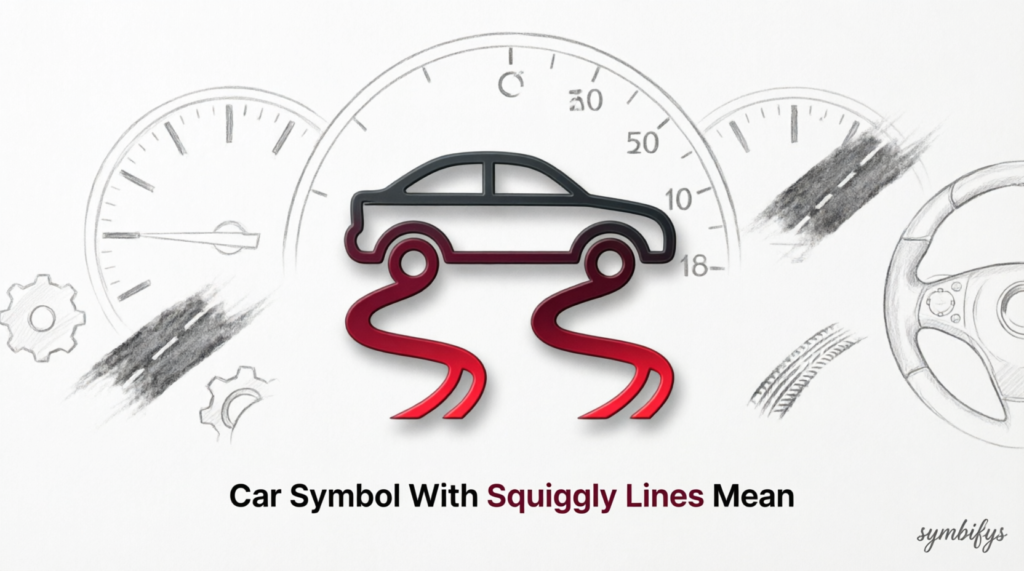
If you have ever looked at your dashboard and noticed a car symbol with squiggly lines underneath it, you may have wondered whether your vehicle has detected a serious problem.
The symbol usually looks like a small car with two curved or wavy lines beneath it. It is commonly associated with your vehicle’s electronic stability control (ESC), traction control, or stability system.
In simple terms, the system is designed to help prevent your car from losing control when the tires begin to slip.
That can happen when driving on rain-soaked roads, snow, ice, gravel, mud, or during a sudden steering maneuver.
The confusing part is that the same symbol can behave differently depending on what your car is doing. If it flashes briefly, the system may simply be working. If it stays illuminated, the system may have been switched off or detected a fault.
This distinction matters.
A dashboard warning light is not just decoration. It is your vehicle’s way of communicating with you when something deserves your attention.
What Does the Car Symbol With Squiggly Lines Mean? – Quick Meaning
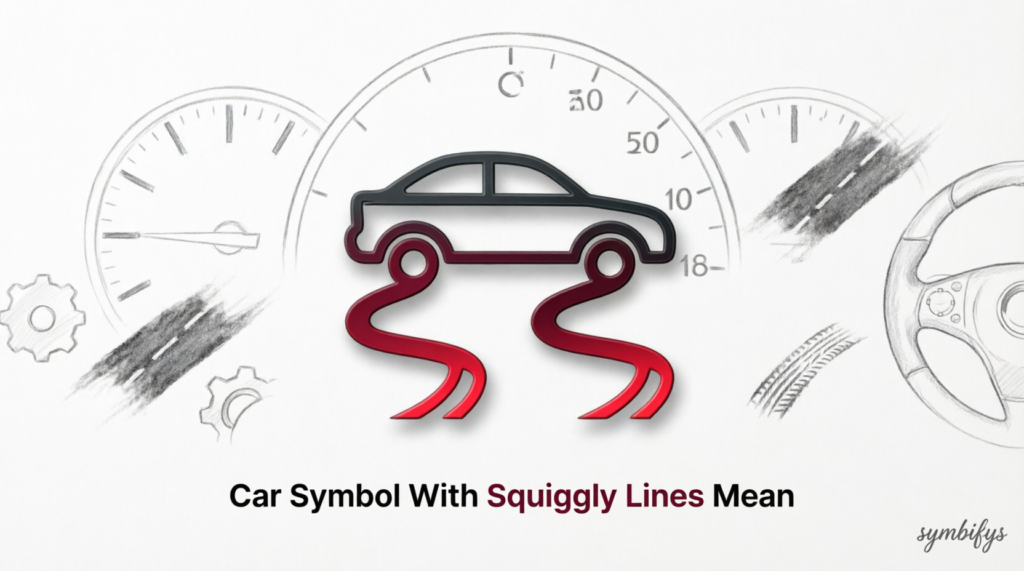
The car with squiggly lines symbol generally represents the vehicle’s stability control or traction-control system.
The exact name varies by manufacturer. You may see terms such as:
- Electronic Stability Control (ESC)
- Electronic Stability Program (ESP)
- Dynamic Stability Control (DSC)
- Vehicle Stability Control (VSC)
- Traction Control System (TCS)
The symbol usually resembles a car appearing to move sideways, with curved lines underneath.
Three common situations are worth remembering:
“The light flashed while I was driving.”
This usually means the traction or stability system detected wheel slip and was actively intervening.
“The light stays on.”
This may mean the system has been switched off or there is a fault that needs checking.
“The light appeared after starting the car.”
A brief illumination during startup can simply be part of the vehicle’s normal self-check.
Your owner’s manual is the best source for the exact meaning because dashboard symbols and system names differ between manufacturers.
Origin & Background
The car-with-squiggly-lines symbol developed alongside modern electronic vehicle safety systems.
Before electronic stability systems became widespread, drivers had to rely much more heavily on steering technique, braking control, tire grip, and road awareness when a vehicle began to slide.
Modern stability systems changed that relationship.
Sensors can monitor things such as wheel speed, steering input, and vehicle movement. When the system detects that the vehicle is not traveling in the direction the driver appears to intend, it can intervene by selectively applying braking and, in some situations, reducing engine power.
The goal is not to make the car impossible to skid.
Instead, the technology is designed to help the driver maintain control when available tire grip becomes limited.
The symbol itself is deliberately visual. Rather than displaying a technical phrase such as “Electronic Stability Control Active,” manufacturers use a recognizable image: a car and wavy lines suggesting sliding.
That visual language has become familiar across countries and vehicle brands.
It has also become increasingly visible online. Drivers regularly post dashboard photos on social media asking questions such as, “What does this light mean?” or “Why is my car flashing this symbol?”
The internet has made dashboard-symbol knowledge much more accessible, but it has also created a problem: the same icon can have slightly different meanings depending on the vehicle.
That is why identifying the symbol is only the first step.
Real-Life Conversations
Person A:
My car just showed a little car with squiggly lines underneath it.
Person B:
Was it flashing?
Person A:
Yeah, for a few seconds when I turned.
Person B:
You may have had some wheel slip. The traction or stability system probably kicked in.
Person A:
So I don’t necessarily need to panic?
Person B:
Not from the flashing light alone. Check your manual if it stays on.
Instagram DMs
Person A:
Do you know what this dashboard symbol means? 🚗〰️
Person B:
Looks like traction/stability control.
Person A:
It came on after heavy rain.
Person B:
That makes sense. Wet roads can make the tires lose grip more easily.
Person A:
I’ll keep an eye on it.
TikTok Comments
Person A:
Why is the little car sliding on my dashboard?
Person B:
That’s usually the stability control light.
Person A:
Mine keeps flashing when I accelerate.
Person B:
If the road is slippery, the system may be detecting wheel slip.
Person A:
Oh, that actually makes sense.
Text Messages
Person A:
The squiggly car light is staying on.
Person B:
Did you turn traction control off?
Person A:
Not that I know of.
Person B:
Then check the owner’s manual and consider getting it inspected, especially if the light stays on after restarting.
Emotional & Psychological Meaning
Unlike social-media symbols, this dashboard icon does not carry a hidden emotional message.
Its meaning is practical: your vehicle is communicating information about traction or stability control.
But the emotional reaction to it can be very real.
A sudden warning light often creates immediate anxiety. Drivers naturally wonder, “Is my car about to break down?”
That reaction is understandable because dashboards communicate complex mechanical information through tiny symbols that most people are expected to recognize instantly.
I remember the general experience of seeing a warning light appear unexpectedly: the first instinct is often to stop everything and search for an explanation. The important thing is to pause rather than panic.
If the symbol flashes briefly while the vehicle is negotiating a slippery surface, it may simply indicate that the system is doing exactly what it was designed to do.
If it remains illuminated, however, it deserves more attention.
The psychological lesson is useful beyond driving: understanding a warning reduces unnecessary fear, but understanding its limits prevents false reassurance.
Usage in Different Contexts
Social Media
People commonly use the car-with-squiggly-lines symbol when asking for help identifying a dashboard warning.
A photo of the icon can make the question easy to understand, but a complete answer requires context.
The vehicle’s make, model, year, weather conditions, and whether the light is flashing or steady can all matter.
Friends & Relationships
Among friends, the symbol often becomes a quick way to ask for practical advice.
Someone may text:
“The slippery-car light came on. Do you know what it is?”
The best response is not simply “It’s traction control.” It is better to ask whether the light is flashing or staying on.
Work / Professional Settings
In professional driving environments, the distinction becomes more important.
Fleet drivers, delivery workers, commercial drivers, and anyone who spends many hours on the road should take persistent warning indicators seriously.
A stability-control problem can matter more when driving frequently, carrying heavy loads, or operating in challenging weather.
Casual vs. Serious Tone
In casual conversation, people might call it:
- “The slippery car light”
- “The squiggly car symbol”
- “The sliding-car icon”
In a professional setting, it is better to use precise terms such as traction control or electronic stability control, when appropriate.
When NOT to Use It
The symbol itself does not have a social “wrong time” to use.
The important issue is how you interpret it.
Do not automatically assume:
- A flashing light means the car is broken.
- A steady light means the tires are definitely worn out.
- The symbol always means exactly the same thing on every vehicle.
- Turning the system off is always safe.
- The car can no longer skid because stability control exists.
You should also avoid treating the warning light as a substitute for safe driving.
Electronic stability systems can help when traction is lost, but they cannot overcome the laws of physics. If you drive too quickly for road conditions, the vehicle can still lose control.
Cultural differences are generally minor because dashboard symbols are designed to communicate across languages.
However, terminology can differ. One manufacturer may call its system ESC, another ESP, and another VSC or DSC.
Common Misunderstandings
“The squiggly lines mean the road is dangerous.”
Not necessarily.
The system may activate because it detects wheel slip, but the light itself does not provide a complete assessment of road danger.
“The light flashing means something is broken.”
Usually, a flashing stability-control indicator can mean the system is actively intervening.
The exact behavior depends on the vehicle.
“A steady light means I should ignore it.”
No.
A persistent warning can indicate that the system has been disabled or that a fault has been detected.
Consult your vehicle’s manual and have the car checked if the light remains on unexpectedly.
“It is the same as the ABS light.”
Not exactly.
ABS and stability-control systems are closely related because they use wheel-speed and braking information, but they serve different functions.
The anti-lock braking system primarily helps prevent the wheels from locking during hard braking.
Stability control goes further by helping manage vehicle direction and traction during situations where the vehicle may begin to deviate from the driver’s intended path.
“Turning traction control off makes the car more powerful and therefore safer.”
Not necessarily.
There are situations where experienced drivers may intentionally disable or reduce traction-control intervention, such as when trying to free a vehicle from deep snow or loose terrain.
For ordinary road driving, however, safety systems should generally be used as intended.
Comparison Table
| Symbol / Term | Meaning | Main Purpose |
|---|---|---|
| Car with squiggly lines | Stability/traction-control indicator | Helps identify traction or stability-system activity |
| Flashing stability light | System may be actively intervening | Helps manage detected wheel slip |
| Steady stability light | System may be off or have a fault | Signals that attention may be needed |
| ABS light | Anti-lock braking system warning | Indicates an ABS-related issue or status |
| Tire-pressure light | Low tire pressure or TPMS warning | Alerts you to tire-pressure problems |
| Check-engine light | Engine/emissions-related warning | Indicates a detected powertrain/emissions issue |
| Hazard lights | Emergency warning lights | Alerts other road users to a stopped or hazardous vehicle |
| Skidding / sliding icon | Common visual representation of traction/stability control | Indicates potential or detected loss of grip |
Key Insight
The car with squiggly lines is best understood as a traction-and-stability symbol, not a general “danger” light. The most important clues are whether it flashes or stays illuminated and what your vehicle’s manual says.
How to Respond When Someone Uses It
If someone asks you about the symbol, your response should depend on the situation.
Casual Replies
- “That’s usually the traction-control or stability light.”
- “It looks like your car detected some wheel slip.”
- “Check whether it’s flashing or staying on.”
Funny Replies
- “Your dashboard thinks the car is auditioning for a drift competition.”
- “Looks like your car has entered slippery mode 😂.”
- “Those squiggly lines aren’t a road map!”
Mature Replies
- “That symbol generally relates to traction or electronic stability control. If it stays on, check your owner’s manual.”
Respectful Replies
- “It usually indicates the stability or traction-control system, but the exact meaning depends on your vehicle. What make and model is it?”
Regional & Cultural Usage
The underlying meaning of the symbol is broadly consistent around the world.
Western Culture
Drivers in North America and Europe commonly encounter terms such as ESC, ESP, and traction control.
Vehicle manufacturers may use different terminology even when the underlying technology performs similar functions.
Asian Culture
Asian vehicle markets include a wide variety of Japanese, Korean, Chinese, European, and American manufacturers.
As a result, drivers may encounter different names for similar stability systems.
Middle Eastern Culture
Drivers may encounter the same dashboard symbol in very different environmental conditions.
Hot climates, dusty roads, occasional heavy rain, and different driving surfaces can all affect how drivers experience traction and stability systems.
Global Internet Usage
The visual design has become especially useful online because a driver can post a dashboard photograph without knowing the technical name of the warning.
People around the world can recognize the basic “car sliding” shape.
Generational Differences
Older drivers may be more familiar with physical driving techniques for recovering from loss of traction, while younger drivers may be more accustomed to electronic assistance.
Neither approach eliminates the need for careful driving.
The best modern driving practice combines human judgment with the safety systems built into the vehicle.
Is It Safe for Kids?
Yes, learning what the symbol means is perfectly safe and can actually be useful for young drivers learning dashboard basics.
The important lesson is that a warning symbol should not be treated casually.
Teen drivers should understand that electronic stability and traction systems are assistance technologies, not permission to drive aggressively.
A vehicle equipped with advanced safety technology can still lose traction, especially when speed, road conditions, tire condition, or weather exceed the available grip.
FAQs
1. What does the car symbol with squiggly lines mean?
It usually represents the vehicle’s traction-control or electronic stability-control system.
2. Why is the car with squiggly lines flashing?
A flashing symbol often means the traction or stability system is actively responding to detected wheel slip.
3. What does it mean if the squiggly car light stays on?
A steady light may mean the system has been switched off or has detected a fault. Check the owner’s manual for your specific vehicle.
4. Is the car with squiggly lines the traction-control light?
Usually, yes. Many vehicles use this symbol to represent traction control, stability control, or both.
5. Can I drive with the stability-control light on?
It depends on why it is illuminated. If the light remains on unexpectedly, consult your owner’s manual and arrange an inspection if necessary.
6. Does the symbol mean my tires are bad?
Not automatically. Wheel slip can have many causes, including wet roads, snow, ice, loose surfaces, acceleration, tire condition, or a system fault.
7. Is electronic stability control important?
Yes. Electronic stability control is an important vehicle-safety technology designed to help drivers maintain directional control when a vehicle begins to lose stability.
Conclusion
So, what does the car symbol with squiggly lines mean?
In most vehicles, it relates to traction control or electronic stability control.
If it flashes briefly while you are driving on a slippery surface, the system may simply be doing its job and responding to wheel slip.
If the light remains illuminated, especially when you did not intentionally switch the system off, it deserves closer attention.
The most useful habit is to avoid guessing from the symbol alone. Check whether the light is flashing or steady, pay attention to the road conditions, and use your vehicle’s owner’s manual to confirm the exact meaning for your model.
A tiny dashboard icon can look alarming when you do not understand it. Once you know what it is communicating, however, the mystery disappears.
And that is really the value of learning dashboard symbols: you become a calmer, more informed driver who can distinguish between a system doing its job and a warning that genuinely needs attention.
descover more post
What Does the Car Symbol With Squiggly Lines Mean? …
What Does the Battery Symbol Mean? Common Signs …
What Does the Trinity Symbol Mean? History and …

Gorge is the lead author at Symbifys.com with 8+ years of experience researching biblical meanings, spiritual symbolism, and dream interpretation. He is passionate about creating accurate, faith-based content that helps readers understand the deeper meaning behind symbols, dreams, numbers, and Scripture. His articles combine careful research with biblical insights to provide clear, practical, and inspiring guidance. Through Symbifys.com, Gorge is dedicated to helping readers strengthen their faith and discover meaningful spiritual understanding. His goal is to publish trustworthy, engaging, and easy-to-read content for a global audience.