It’s easy to spot the Trinity symbol on a necklace, an old church, or a Celtic design and wonder what it actually means. At first glance, it looks simple, but its meaning has changed across different cultures and beliefs over the centuries.
So, what does the Trinity symbol mean? For Christians, it represents the Father, Son, and Holy Spirit. In Celtic traditions, it can symbolize eternity, the cycles of nature, or the connection between mind, body, and spirit. The meaning depends on where the symbol appears and the tradition behind it, which is exactly what makes it so fascinating.
Featured Snippet
The Trinity symbol represents three connected parts that form one complete whole. In Christianity, it stands for the Father, Son, and Holy Spirit. In Celtic tradition, it often symbolizes eternity, balance, the natural cycles of life, or the connection between mind, body, and spirit. Its meaning varies based on its cultural, historical, and spiritual context.
What Is the Trinity Symbol?
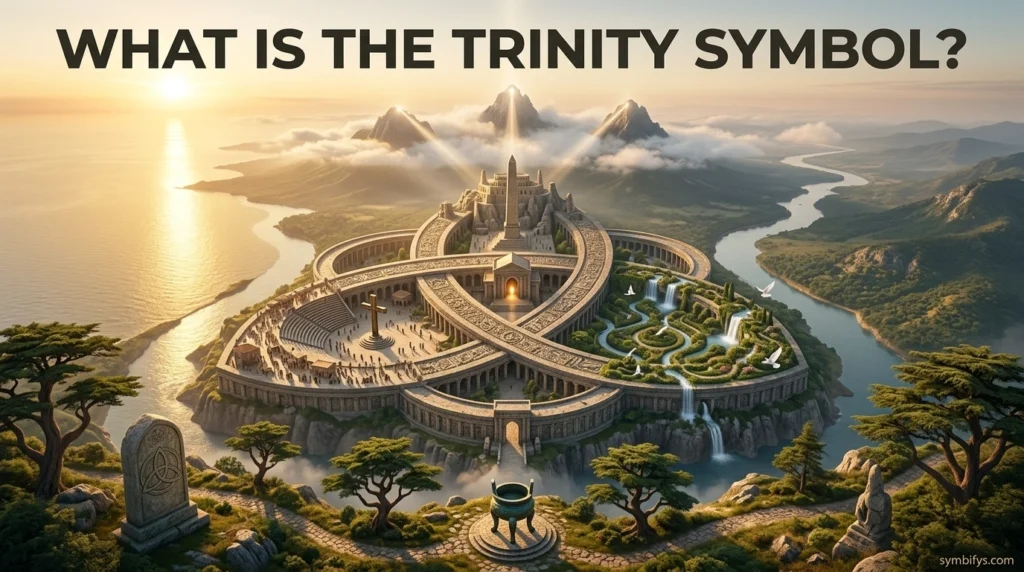
The Trinity symbol refers to several designs built around the number three, but the most recognized version is the Triquetra—a three-cornered knot made from one continuous line.
The symbol has no beginning or end, making it a powerful image of eternity and unity.
Although many people simply call it the “Trinity symbol,” similar three-part symbols have appeared in different civilizations for thousands of years.
Common Trinity Symbols
| Symbol | Primary Meaning | Most Common Association |
|---|---|---|
| Triquetra | Unity, eternity, three-in-one | Christianity and Celtic tradition |
| Celtic Trinity Knot | Eternal interconnectedness | Celtic culture |
| Borromean Rings | Three inseparable parts | Mathematics, theology |
| Triskelion | Motion and life’s cycles | Ancient Celtic and Greek cultures |
Each symbol shares the idea that three separate elements work together as one.
History and Origin of the Trinity Symbol
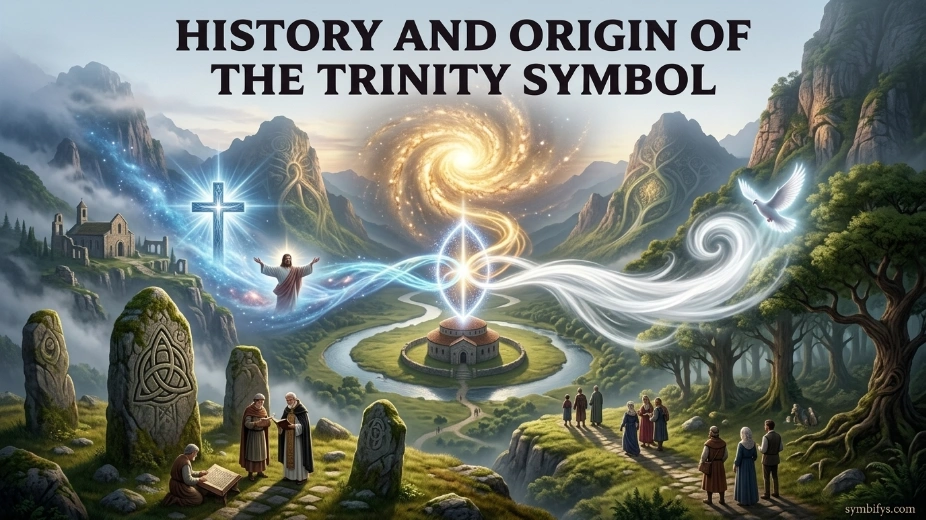
The Trinity symbol existed long before Christianity.
Archaeologists have discovered three-part knot patterns in ancient Europe dating back more than 2,000 years. Celtic artists frequently carved these designs into stone monuments, illuminated manuscripts, jewelry, and metalwork.
The number three held special importance in many ancient societies because it appeared repeatedly in nature:
- Birth, life, and death
- Past, present, and future
- Land, sea, and sky
- Morning, noon, and night
Because of these natural groupings, the number three became associated with completeness and harmony.
How Christianity Adopted the Symbol
When Christianity spread through Celtic regions during the early Middle Ages, many existing artistic symbols were incorporated into Christian artwork.
The Triquetra gradually became associated with the Holy Trinity:
- God the Father
- God the Son (Jesus Christ)
- God the Holy Spirit
While the Bible does not mention the Triquetra itself, medieval Christian artists used it to visually represent the theological concept of one God existing in three distinct persons.
What Does the Trinity Symbol Mean Spiritually?
Spiritually, the Trinity symbol often represents wholeness through unity.
Rather than emphasizing three separate parts, it reminds people that different aspects of existence can work together in harmony.
Common spiritual interpretations include:
- Mind, body, and spirit
- Creation, preservation, and transformation
- Beginning, middle, and end
- Heaven, Earth, and humanity
- Balance between physical and spiritual life
Many people wear the symbol as a reminder to seek balance rather than perfection.
The Christian Meaning of the Trinity Symbol
For Christians, the Trinity symbol represents one of the central teachings of the faith.
According to Christian doctrine:
- The Father is God.
- The Son is God.
- The Holy Spirit is God.
- Yet there is only one God.
This teaching is known as the Holy Trinity.
The Trinity symbol visually expresses unity without suggesting that the three persons are separate gods.
What the Bible Says
The Bible never describes God using the Triquetra or another Trinity symbol.
Instead, the doctrine comes from passages that mention the Father, Son, and Holy Spirit together.
Examples include:
- Matthew 28:19
- 2 Corinthians 13:14
- John 14–16
Over centuries, Christian theologians developed symbols that helped explain these teachings through art.
The Celtic Meaning of the Trinity Symbol
Before its Christian association, the Trinity symbol already held deep significance in Celtic culture.
The Celts viewed nature as interconnected, with life moving through repeating cycles.
Common Celtic meanings include:
- Earth, sea, and sky
- Maiden, mother, and elder
- Life, death, and rebirth
- Body, mind, and soul
- Eternal cycles of nature
Unlike later Christian interpretations, these meanings were closely tied to the natural world rather than formal religious doctrine.
Symbolism Behind the Three Connected Loops
One reason the Trinity symbol remains powerful is its simple yet meaningful design.
Every part contributes to its symbolism.
| Design Element | Symbolic Meaning |
|---|---|
| Three loops | Three connected aspects of existence |
| Continuous line | Eternity without beginning or end |
| Interwoven design | Unity and interconnectedness |
| Symmetry | Harmony and balance |
The symbol communicates complex ideas without using words.
Why the Number Three Is So Important
Many traditions view three as a number of completion.
Examples appear throughout history:
- Three dimensions of space
- Three primary colors
- Three phases of water
- Beginning, middle, end
- Birth, life, death
Psychologists also note that humans naturally organize information into groups of three because they are easier to remember and understand.
This cognitive preference may partly explain why three-part symbols appear in cultures around the world.
Different Cultural Interpretations
The Trinity symbol has taken on unique meanings depending on where and how it is used.
Christianity
Represents the Holy Trinity.
Celtic Traditions
Represents harmony, eternity, and nature’s cycles.
Modern Spirituality
Represents inner balance and personal growth.
Family Symbolism
Some families interpret it as:
- Parent one
- Parent two
- Child
Personal Development
Others see it as balancing:
- Thoughts
- Emotions
- Actions
The flexibility of the symbol has helped it remain meaningful across generations.
Common Uses of the Trinity Symbol
Today, the Trinity symbol appears in many settings.
Jewelry
Necklaces, rings, bracelets, and earrings often feature the design as a symbol of faith, love, or eternity.
Tattoos
Many people choose Trinity tattoos to represent:
- Family bonds
- Spiritual beliefs
- Personal transformation
- Eternal love
- Balance in life
Religious Art
Churches frequently include Trinity symbols in stained glass, carvings, and illuminated manuscripts.
Home Décor
The design appears on wall art, wood carvings, candles, and decorative pieces inspired by Celtic heritage.
What Do Different Colors Mean?
The Trinity symbol itself has no official color.
However, artists often use color to add symbolic meaning.
| Color | Common Interpretation |
|---|---|
| Gold | Divinity, wisdom, eternity |
| Silver | Purity, peace |
| Green | Celtic heritage, growth, nature |
| Blue | Faith, trust, heaven |
| Purple | Spirituality, royalty |
| Black | Strength, mystery |
| White | Holiness, new beginnings |
These meanings are based on artistic tradition rather than fixed religious teaching.
Psychological Meaning
From a psychological perspective, people are naturally drawn to symbols that simplify complex ideas.
The Trinity symbol represents integration.
Instead of choosing between competing parts of ourselves, it encourages balance.
For example:
- Logic and emotion
- Work and family
- Strength and compassion
Modern therapists sometimes discuss personal growth in terms of integrating different aspects of identity, although they do not typically use the Trinity symbol itself as a clinical tool.
Its appeal often comes from its visual reminder that wholeness can include diversity rather than uniformity.
Benefits of the Trinity Symbol
People value the symbol for different reasons.
Common benefits include:
- Encourages reflection
- Represents unity
- Inspires spiritual connection
- Honors cultural heritage
- Reminds people to seek balance
- Serves as a meaningful personal symbol
- Connects families through shared traditions
The meaning ultimately depends on the individual using it.
Common Misunderstandings
Several myths surround the Trinity symbol.
| Myth | Reality |
|---|---|
| It was invented by Christianity. | Similar designs existed centuries earlier. |
| It always represents the Holy Trinity. | Its meaning changes across cultures. |
| Every Trinity knot has religious meaning. | Some are purely decorative. |
| It has magical powers. | No scientific evidence supports supernatural claims. |
Understanding these distinctions helps avoid confusion.
Is the Trinity Symbol Biblical?
This question often appears when people encounter the symbol in churches.
The answer is nuanced.
The doctrine of the Trinity is a core belief in many Christian denominations, developed from biblical teachings about the Father, Son, and Holy Spirit.
However, the Triquetra symbol itself does not appear in the Bible.
It developed later as a visual teaching aid in Christian art.
This distinction is important because it separates biblical teaching from later artistic tradition.
Expert Perspective
Historians generally agree that the Trinity symbol evolved over time rather than originating from a single religion or civilization.
Religious scholars distinguish between:
- Ancient Celtic artistic traditions
- Christian theological symbolism
- Modern spiritual interpretations
- Contemporary personal symbolism
These perspectives are not mutually exclusive. Instead, they reflect how symbols often gain new meanings as cultures interact across centuries.
Practical Tips for Choosing or Wearing the Trinity Symbol
If you’re considering wearing or displaying the symbol, think about what it personally represents to you.
Consider these questions:
- Does it reflect your faith?
- Are you honoring your Celtic ancestry?
- Does it remind you to seek balance?
- Is it a family symbol?
- Are you drawn to its artistic beauty?
Knowing your own reason helps the symbol carry deeper personal significance.
Frequently Asked Questions
Is the Trinity symbol the same as the Celtic knot?
No. The Triquetra is one type of Celtic knot, but Celtic knots come in many different designs, each with its own meaning and history.
Can someone wear the Trinity symbol without being Christian?
Absolutely. Many people wear it because they appreciate its Celtic heritage, artistic design, or personal symbolism rather than its religious meaning.
Does the Trinity symbol represent eternity?
Yes, in many traditions. Its unbroken line is often seen as a symbol of eternity because it has no clear beginning or end.
Why is the Trinity symbol popular in jewelry?
People are drawn to its simple design and meaningful symbolism. It can represent faith, family, unity, or a connection to Celtic heritage.
Is the Trinity symbol considered lucky?
Some cultures associate it with protection or good fortune, but that belief isn’t universal. Its meaning depends on personal and cultural traditions.
What’s the difference between the Trinity symbol and the Triskelion?
The Trinity symbol focuses on unity and the connection between three parts. The Triskelion, on the other hand, is more commonly linked to movement, growth, and the ongoing cycles of life.
Is the Trinity symbol associated with marriage?
For some couples, yes. It can symbolize a lasting bond, shared faith, or a lifelong commitment, even though it isn’t an official marriage symbol.
Why does the Trinity symbol appear in medieval artwork?
Medieval artists often used it to represent the Christian Trinity and other spiritual ideas. Its distinctive shape made it a powerful visual symbol in religious art.
Does the Trinity symbol have a single universal meaning?
No. Its meaning changes depending on the religious, cultural, or historical context in which it’s used.
Can the Trinity symbol have more than one meaning at the same time?
Yes. Someone might see it as a symbol of Christian faith while also viewing it as a reminder of unity, balance, or family.
Conclusion
The Trinity symbol has endured because it speaks to a universal idea: different parts can belong to one complete whole.
Whether you understand it through Christian theology, Celtic tradition, personal spirituality, or cultural heritage, its enduring design invites reflection on connection, harmony, and continuity. Rather than having one fixed interpretation, the symbol has gathered layers of meaning across centuries.
Appreciating its history and context allows you to understand why this simple three-part design continues to inspire people around the world.
Discover More Post
What Does the Deathly Hallows Symbol Mean? Its Hidden Meaning Explained 2026
What Does the Battery Symbol Mean? Common Signs Explained 2026
What Does the Car With Lock Symbol Mean? Common Causes & Fixes 2026

Mia Enderson is a dedicated content writer and digital research specialist with over 7 years of experience creating insightful and reader-focused content. She specializes in technology, business, and online trends, delivering well-researched and engaging articles. At Symbifys.com, Mia is committed to providing accurate, valuable, and easy-to-understand information that helps readers make informed decisions. Her passion for quality content and attention to detail have earned the trust of a growing audience.