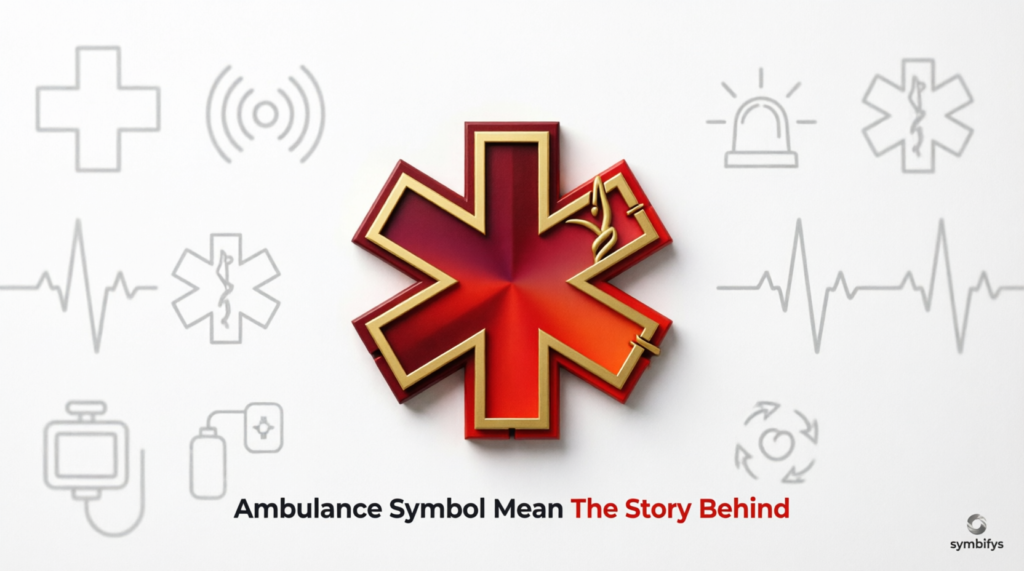
If you have ever looked at an ambulance and wondered, “What does the ambulance symbol mean?”, you may have noticed the blue six-pointed star with a snake and staff in the middle.
That symbol is called the Star of Life.
It is much more than a decorative medical logo. The six arms of the star represent the six major functions of emergency medical services: detection, reporting, response, on-scene care, care in transit, and transfer to definitive care. The snake and staff in the represent medicine and healing through the ancient Rod of Asclepius.
People often search for the ambulance symbol because they recognize the image but do not know what its individual parts mean. Others confuse it with a simple medical cross, the Red Cross emblem, or the Caduceus, which has two snakes.
Understanding the symbol makes something familiar suddenly much more meaningful. The next time you see the Star of Life on an ambulance, highway sign, medical uniform, or emergency equipment, you will know that it represents an entire chain of emergency care—not simply a vehicle going to a hospital.
What Does the Ambulance Symbol Mean – Quick Meaning
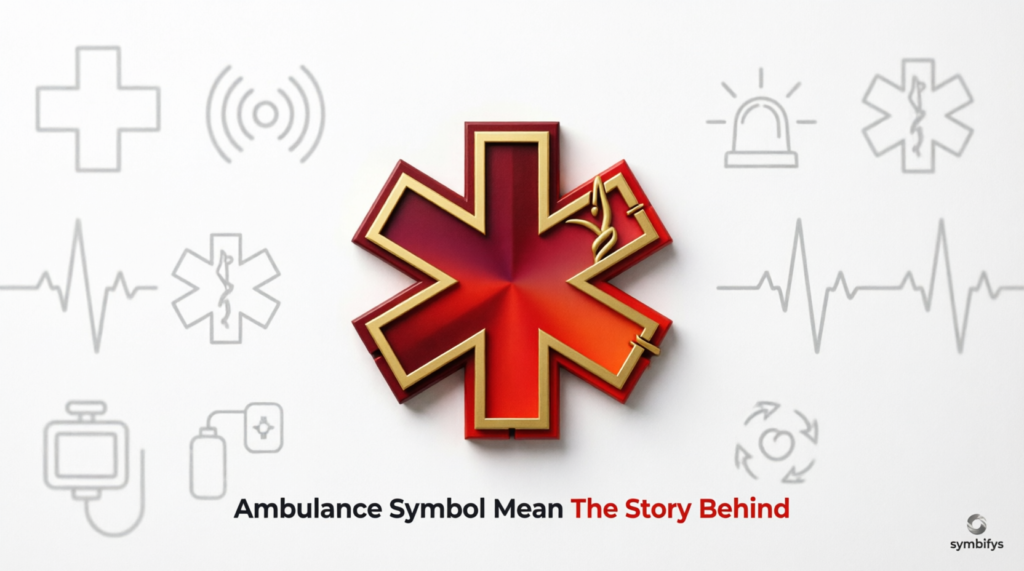
The familiar blue ambulance symbol is usually the Star of Life, an internationally recognized symbol associated with emergency medical services.
Its main elements have specific meanings:
- Six-pointed star: Represents six functions of EMS.
- Snake and staff: Represents the Rod of Asclepius, an ancient symbol of medicine and healing.
- Blue color: Commonly associated with the EMS Star of Life, although actual ambulance markings vary by country and service.
- Overall symbol: Identifies emergency medical services and access to emergency medical care.
The six EMS functions are:
- Detection
- Reporting
- Response
- On-scene care
- Care in transit
- Transfer to definitive care
In everyday language, the symbol tells you:
“Emergency medical care is connected to this place, vehicle, service, or information.”
For example:
“The Star of Life is on the ambulance.”
Or:
“Look for the blue Star of Life on the highway sign.”
And:
“The symbol identifies emergency medical services.”
Origin & Background
The story behind the ambulance symbol combines modern emergency medicine with imagery that goes back thousands of years.
The modern Star of Life
The Star of Life was created by the U.S. National Highway Traffic Safety Administration (NHTSA) to provide a recognizable symbol for emergency medical services.
NHTSA adapted the six-barred cross from the American Medical Association’s medical identification symbol. Each bar was then given a specific EMS meaning.
The symbol became associated with emergency medical care around the world and is now commonly seen on ambulances, emergency equipment, EMS uniforms, educational materials, maps, and highway signs.
This is important because an ambulance is not simply transportation.
Modern EMS is a coordinated system involving communication, trained personnel, transportation, healthcare facilities, and emergency medical treatment.
The symbol therefore represents a system of care, not merely a vehicle.
The snake and staff
The image in the center is the Rod of Asclepius.
Asclepius was an ancient Greek figure associated with healing and medicine. The World Health explains that the staff with a snake has long been used as a symbol of medicine and the medical profession.
The snake is sometimes surprising to people.
Why would a snake appear on an ambulance?
In the symbolism associated with Asclepius, the snake is connected with ideas such as healing and renewal. EMS.gov specifically explains the staff as representing medicine and healing, while the shedding of the serpent’s skin can suggest renewal.
Cultural influence
The remarkable thing about the symbol is the way two very different histories meet.
The six-pointed star is a modern representation of emergency medical services.
The serpent and staff reach back to ancient Greek medical symbolism.
Together, they communicate a simple idea across languages and cultures: medical help is available here.
Social media impact
Social media has made medical symbols easier to encounter outside hospitals and ambulances.
People photograph ambulances, share emergency preparedness information, post medical education videos, and ask questions about symbols they have seen.
That has also created confusion.
A quick social-media explanation might call every snake-and-staff symbol a “medical symbol” without explaining the difference between the Rod of Asclepius and the Caduceus.
The distinction matters.
The Rod of Asclepius has one snake.
The Caduceus traditionally has two snakes and wings.
The Star of Life uses the Rod of Asclepius in its center.
Real-Life Conversations
These examples show how people might naturally talk about the ambulance symbol in everyday digital communication.
Person A:
What does that blue star on the ambulance mean?
Person B:
That’s the Star of Life.
Person A:
Is it just a medical logo?
Person B:
Not exactly. The six points represent six stages of emergency medical service.
Person A:
I had no idea each point meant something.
Person B:
Yeah, it’s basically a whole emergency-care system in one symbol.
Instagram DMs
Person A:
Why does the ambulance have a snake on it? 😭
Person B:
It’s the Rod of Asclepius.
Person A:
Isn’t the snake symbol the Caduceus?
Person B:
That’s a common mix-up. The Caduceus has two snakes and wings. The Star of Life uses the single-snake Rod of Asclepius.
Person A:
Okay, that actually makes sense now.
TikTok Comments
Person A:
What is the blue star called?
Person B:
Star of Life.
Person A:
What do the six arms mean?
Person B:
Detection, reporting, response, on-scene care, care in transit, and transfer to definitive care.
Person A:
That’s way deeper than I expected.
Person B:
Same. I thought it was just a logo.
Text Messages
Person A:
I saw that symbol outside the emergency department.
Person B:
The blue star?
Person A:
Yeah.
Person B:
It’s used to identify EMS and emergency medical care.
Person A:
So if I’m looking for emergency services, I should recognize it?
Person B:
Exactly. That’s one of the reasons recognizable symbols matter.
Emotional & Psychological Meaning
The Star of Life is not an emotional expression in the way a heart, smiley face, or crying emoji is.
Its emotional power comes from what people associate with emergency care.
For one person, seeing the symbol may bring relief: an ambulance has arrived.
For another, it may immediately trigger anxiety because they associate it with an accident, illness, or difficult family experience.
For an EMS professional, the same symbol can represent responsibility, training, teamwork, and service.
That difference is psychologically important.
Symbols are interpreted through experience. The image itself is neutral, but the circumstances surrounding it can make it feel comforting, frightening, reassuring, or deeply personal.
Imagine seeing the Star of Life after a serious road accident.
You may not consciously think about its six functions or ancient Greek history. You simply see it and think:
Help is here.
That is the practical emotional strength of an emergency symbol.
It communicates quickly when people may not have the time—or emotional capacity—to read a paragraph of instructions.
Usage in Different Contexts
Social Media
Online, the Star of Life usually appears in:
- Emergency preparedness posts
- Ambulance photographs
- First-aid education
- EMS career content
- Hospital and emergency-care discussions
- Public safety information
People may casually call it the “ambulance star,” “medical star,” or “EMS symbol,” although Star of Life is the established name.
Friends & Relationships
In casual conversation, you can simply say:
“That’s the Star of Life on the ambulance.”
There is no special slang meaning attached to it.
If someone asks why there is a snake, a short explanation is usually enough:
“It’s the Rod of Asclepius, an ancient symbol of medicine.”
Work / Professional Settings
In professional healthcare and emergency-service contexts, precision matters.
It is better to distinguish between:
- Star of Life
- Rod of Asclepius
- Caduceus
- Red Cross emblem
- Other national or organizational medical symbols
EMS itself is broader than ambulance transportation. Official EMS guidance describes it as a coordinated emergency medical system involving people, organizations, communications, transportation, and medical facilities.
Casual vs. Serious Tone
“What’s that ambulance star?” is perfectly natural in casual conversation.
In a professional article, “Star of Life” is clearer and more accurate.
The audience should determine how much terminology you introduce.
When NOT to Use It
The Star of Life is generally straightforward, but context still matters.
Don’t Treat It as a Universal Ambulance Logo
Not every country or ambulance service uses exactly the same markings.
Emergency medical systems vary significantly between regions and jurisdictions.
Don’t Confuse It With the Caduceus
This is probably the most common symbolic mistake.
The Star of Life contains the Rod of Asclepius, not the traditional Caduceus.
Don’t Assume It Means “Hospital”
The Star of Life primarily identifies EMS and emergency medical care.
A hospital may use different symbols to identify departments, services, or facilities.
Don’t Use Medical Emblems Carelessly
Some medical and humanitarian emblems have protected or restricted uses.
For example, the World Health Organization states that use of its own emblem is restricted to institutions with official collaborating status and appropriate WHO-related work.
So a symbol that looks medical should not automatically be treated as generic decoration in professional contexts.
Common Misunderstandings
“The ambulance symbol is just a blue star.”
Visually, that is understandable, but the design has a specific structure.
The six arms correspond to six EMS functions.
“The snake represents danger.”
Not in this context.
Within the Star of Life, the serpent and staff come from the Rod of Asclepius and represent medicine and healing.
“The Caduceus is the ambulance symbol.”
Not technically.
The Caduceus has two snakes and wings. The Star of Life uses the single serpent and staff associated with Asclepius.
“Each point represents a different medical treatment.”
No.
The six points represent stages or functions of emergency medical services, from detecting an emergency through transfer to definitive care.
“Every ambulance everywhere has the same symbol.”
No.
Emergency vehicle designs and EMS identification systems vary by country and service.
“The symbol means the person is already in danger.”
Not necessarily.
Seeing the Star of Life can simply indicate an EMS vehicle, service, resource, or location.
Comparison Table
| Symbol or expression | Meaning | Common context |
|---|---|---|
| Star of Life | Identifies EMS and emergency medical care | Ambulances, EMS equipment, signs |
| Rod of Asclepius | Medicine and healing | Medical symbolism |
| Caduceus | Traditionally associated with Hermes; often mistakenly used for medicine | General symbolic use |
| Red Cross emblem | Humanitarian/medical protection and Red Cross movement | Humanitarian settings |
| Medical cross | General healthcare or medical identification | Clinics, pharmacies, signs |
| Ambulance | Vehicle used for emergency or medical transport | Emergency services |
| EMS | Emergency Medical Services | Professional healthcare |
| Emergency symbol | Broad visual indicator of urgent assistance | Public safety |
| First-aid symbol | Indicates first-aid assistance or supplies | First-aid locations |
| Hospital symbol | Indicates healthcare facilities | Maps and public signage |
Key Insight
The Star of Life is specifically tied to emergency medical services, while the Rod of Asclepius is the medical symbol contained inside it. Knowing that distinction makes the entire design easier to understand.
Variations / Types
The Star of Life may appear in different settings and visual treatments while retaining its core meaning.
1. Blue Star of Life
The classic blue six-pointed EMS symbol.
It is the version most people associate with ambulances and emergency medical services.
2. Star of Life With Rod of Asclepius
The complete symbol includes the serpent and staff in the center.
This connects modern EMS with the ancient symbolism of medicine and healing.
3. Ambulance Star of Life
Placed on an ambulance, it identifies the vehicle with emergency medical services.
4. EMS Uniform Symbol
EMS clinicians may wear the symbol on patches, apparel, or equipment.
It helps identify their connection with emergency medical care.
5. Highway Star of Life
The symbol can appear on maps and highway signs to identify locations or access points associated with qualified emergency medical care.
6. Medical Equipment Star
Emergency equipment can carry the symbol to indicate its connection with EMS.
7. Educational Star of Life
EMS organizations use it on manuals, books, reports, pamphlets, and educational materials.
8. Digital Star of Life
The same recognizable design may appear on websites, social-media graphics, and digital educational materials.
9. Monochrome Star of Life
The symbol can be reproduced in a single color for printing, design, or identification purposes.
The visual treatment can change without changing its fundamental concept.
10. Customized EMS Branding
Some emergency services incorporate the Star of Life into broader organizational branding.
The surrounding design may vary even though the central symbol remains recognizable.
How to Respond When Someone Uses It
If someone asks, “What does the ambulance symbol mean?”, your response can match their level of interest.
Casual Replies
- “That’s the Star of Life. It identifies emergency medical services.”
- “It’s the EMS symbol you often see on ambulances.”
- “The six-pointed star represents different stages of emergency care.”
Funny Replies
- “It’s basically the emergency-services version of a signpost.”
- “That snake isn’t there to scare anyone—it represents medicine.”
- “Six points, one snake, and a surprisingly long history.”
Mature Replies
- “It’s called the Star of Life. Its six arms represent the six functions of EMS, while the central staff and serpent represent medicine and healing.”
Respectful Replies
- “It’s the Star of Life, a symbol used to identify emergency medical services.”
- “The central serpent and staff come from the Rod of Asclepius, an ancient medical symbol.”
If someone is asking during an actual emergency, however, the symbol’s history is secondary. Follow local emergency instructions and seek appropriate emergency assistance rather than delaying care to investigate the emblem.
Regional & Cultural Usage
Western Culture
In the United States and other Western countries, the Star of Life is strongly associated with ambulances, EMTs, paramedics, emergency departments, and prehospital medical care.
In the United States, NHTSA created the Star of Life specifically to provide a recognizable identification symbol for EMS.
Asian Culture
Across Asian countries, emergency medical symbols can be especially useful because they provide visual communication across different languages.
The exact ambulance design varies by country, but recognizable medical imagery can help people identify emergency services quickly.
Middle Eastern Culture
The Star of Life may be recognized alongside national ambulance-service branding and other medical symbols.
Because emergency services differ between countries, people should pay attention to the local ambulance markings and emergency number, rather than assuming that every system operates identically.
Global Internet Usage
The internet has made the Star of Life increasingly universal.
A person may recognize it without knowing the English phrase “Emergency Medical Services.”
That is precisely what makes strong visual symbols useful: they can communicate before language does.
Gen Z vs. Millennials
Gen Z users may encounter the symbol through TikTok explainers, short videos, memes, gaming, emergency-preparedness content, and social-media posts.
Millennials may have first learned it from physical ambulances, hospitals, television, road signs, or school first-aid lessons.
The meaning remains the same, but the route through which people learn it has changed.
Is It Safe for Kids?
Yes. The Star of Life is a normal medical and emergency-services symbol.
For children, understanding it can actually be useful. A child who recognizes the symbol may begin to understand that it is connected with emergency medical help.
Parents and teachers can explain it without frightening children: the symbol does not mean that something terrible is necessarily happening. It identifies a service designed to help people during medical emergencies.
It can also be an excellent starting point for teaching children about emergency preparedness and when to seek adult help.
FAQs
What is the ambulance symbol called?
The familiar six-pointed blue symbol is called the Star of Life. It identifies emergency medical services.
What does the Star of Life mean?
Its six arms represent detection, reporting, response, on-scene care, care in transit, and transfer to definitive care.
Why is there a snake on the ambulance symbol?
The snake and staff represent the Rod of Asclepius, an ancient symbol associated with medicine and healing.
Is the ambulance symbol the Caduceus?
No. The Star of Life contains the Rod of Asclepius, which traditionally has one snake. The Caduceus has two snakes and wings.
Why does the Star of Life have six points?
The six points represent the six major functions of EMS, from detecting an emergency through transferring a patient to definitive care.
Is the Star of Life used only on ambulances?
No. It can also appear on EMS equipment, uniforms, educational materials, maps, and highway signs identifying emergency medical services or access to qualified emergency care.
Does every country use the Star of Life?
No. Ambulance markings and emergency medical systems vary internationally. The Star of Life is widely recognized, but local symbols and vehicle designs can differ.
Conclusion
So, what does the ambulance symbol mean?
The familiar six-pointed star is the Star of Life, a symbol created to provide clear identification for emergency medical services.
Its six arms are not random decoration. They represent the chain of EMS care: detection, reporting, response, on-scene care, care in transit, and transfer to definitive care. At its , the Rod of connects modern emergency medicine with an ancient tradition of medical symbolism.
What I find most meaningful about the symbol is how quickly it communicates.
You do not need to speak the same language. You do not need to understand medical terminology. When you see that familiar star on an ambulance or emergency sign, you can recognize that it is connected with people whose job is to respond when someone needs urgent medical help.
A simple symbol carries an enormous human idea:
Help is on the way.
descover more post
What Does the Delta Symbol Mean? 7 Key Uses 2026
What Does the Orange Car Symbol Mean? 9 Common …
What Does This Symbol Mean (!) Meaning Uses History …

Gorge is the lead author at Symbifys.com with 8+ years of experience researching biblical meanings, spiritual symbolism, and dream interpretation. He is passionate about creating accurate, faith-based content that helps readers understand the deeper meaning behind symbols, dreams, numbers, and Scripture. His articles combine careful research with biblical insights to provide clear, practical, and inspiring guidance. Through Symbifys.com, Gorge is dedicated to helping readers strengthen their faith and discover meaningful spiritual understanding. His goal is to publish trustworthy, engaging, and easy-to-read content for a global audience.