If you have ever seen the familiar Masonic symbol—a square and compasses with a letter G in the center—you may have wondered what that single letter actually means.
So, what does the G mean in the Masonic symbol?
The short answer is that G is commonly associated with both “God” and “Geometry,” although the precise interpretation varies between Masonic jurisdictions, traditions, and degrees. It is not simply a decorative letter placed inside the square and compasses. It connects two ideas that have long been important to Masonic symbolism: belief in a Supreme Being and the mathematical principles associated with building, order, and proportion.
That distinction matters because many websites give one absolute answer—usually “God”—when the history is more nuanced.
The symbolism also makes sense when you understand Freemasonry’s broader use of building imagery. Modern Freemasonry traces part of its symbolic language to medieval stonemasons and uses tools such as the square and compasses as moral teaching devices.
What Does the G Mean in the Masonic Symbol – Quick Meaning
In the familiar square-and-compasses Masonic emblem, the letter G most commonly points to two related concepts:
- God — representing the Supreme Being and the spiritual dimension of Masonic thought.
- Geometry — representing the science of measurement, proportion, order, and the principles underlying construction.
- The Great Geometer or Great Architect — in some Masonic traditions, the two ideas are brought together through titles referring to God as the creator or ordering intelligence of the universe.
A useful way to understand it is this:
“G can represent God.”
“G can also represent Geometry.”
“The exact interpretation depends on the Masonic tradition.”
The second point is especially important. Historical Masonic sources show that the meaning of G has not been completely uniform across countries or degrees. One documented tradition, for example, explicitly associates G with God in one degree and Geometry in another.
So if someone asks, “Does the G stand for God or Geometry?”, the most historically responsible answer is: it can mean either, and sometimes both.
Origin & Background
The story begins with the wider symbolism of Freemasonry rather than with the letter G alone.
Freemasonry developed a symbolic vocabulary based heavily on the craft of building. The United Grand Lodge of England describes its origins as being rooted in traditions associated with medieval stonemasons, while emphasizing that modern Freemasonry uses building analogies to encourage moral and personal development.
That explains why the square and compasses became so recognizable.
A square can suggest accuracy, fairness, and proper conduct. Compasses can suggest boundaries, proportion, and disciplined action. The combination turns practical building instruments into symbols of how a person should construct a life.
The letter G became associated with this symbolism over time.
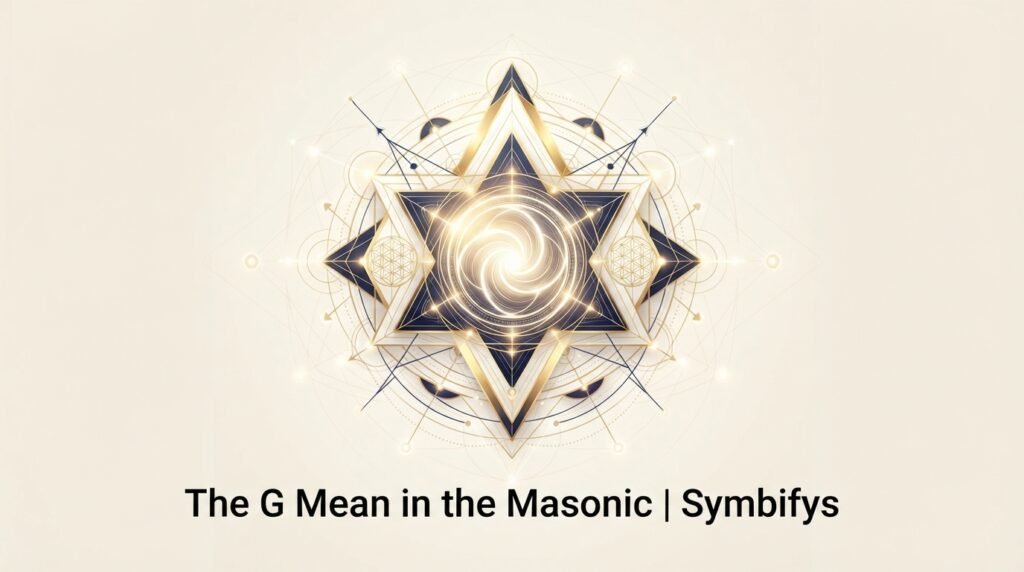
There is an interesting historical complication here: the G was not always presented in exactly the same way everywhere. Historical evidence records different treatments of the letter in various Masonic traditions. In some contexts it appeared separately, while in others it was incorporated into a star or other symbolic arrangement.
The development of Freemasonry during the 18th century helped spread these symbols internationally. The publication of James Anderson’s Constitutions in 1723 was particularly influential, and editions and adaptations subsequently appeared in Ireland, America, France, Germany, and elsewhere.
Cultural influence and social media
For much of its history, the Masonic emblem was encountered on lodge buildings, jewelry, books, architectural objects, gravestones, regalia, and historical documents.
Today, the symbol travels much faster.
A photograph of an old building can place the square and compasses in front of millions of people within hours. TikTok videos, Instagram posts, Reddit discussions, documentaries, tattoos, and online debates have also made people increasingly curious about the G.
The downside is that social media often removes context.
A symbol with centuries of history can become a one-line caption: “The G means God.”
That may be broadly correct in some contexts, but it can hide the more complicated relationship between God, Geometry, architectural symbolism, and different Masonic traditions.
Real-Life Conversations
WhatsApp conversation
Person A:
I saw the Masonic symbol today. What does the G stand for?
Person B:
Usually God, I think.
Person A:
I read somewhere it means Geometry.
Person B:
Actually, both explanations exist. It depends on the tradition.
Person A:
So it’s not just one fixed meaning?
Person B:
Exactly. That’s the interesting part.
Instagram DM
Person A:
That necklace has the Masonic G on it. Is it religious?
Person B:
It can have religious meaning, but Freemasonry isn’t itself a religion.
Person A:
Then why the G?
Person B:
It’s commonly connected with God and Geometry. The religious interpretation is part of the symbolism, not necessarily a statement that everyone follows one particular religion.
That distinction is consistent with the position of the United Grand Lodge of England, which describes Freemasonry as secular and non-religious while requiring members to profess belief in a Supreme Being.
TikTok comments
Commenter 1:
What does the G mean?
Commenter 2:
God.
Commenter 3:
No, geometry.
Commenter 4:
Both can be right. Masonic meanings aren’t identical everywhere.
Commenter 3:
Ohhh, that explains why I keep seeing different answers.
Text messages
Person A:
Why is there a letter in the middle of the Masonic compass?
Person B:
It’s the G.
Person A:
Okay… but what’s G?
Person B:
Often God or Geometry.
Person A:
Which one?
Person B:
That’s where the history gets interesting.
Emotional & Psychological Meaning
Symbols work partly because they compress complicated ideas into something the mind can remember.
The letter G is tiny, but the concepts associated with it are enormous: order, creation, knowledge, measurement, belief, discipline, and the search for meaning.
For someone who understands G as “God,” the symbol can serve as a reminder that human life exists within something larger than the individual.
For someone emphasizing “Geometry,” it can suggest that the universe and human construction are governed by patterns, proportion, and relationships.
Psychologically, that is powerful.
People naturally use symbols to give physical form to abstract values. A wedding ring represents commitment. A flag represents collective identity. A graduation cap can represent achievement. Likewise, a Masonic emblem can carry layers of meaning that would take pages to explain in words.
Imagine someone wearing a small square-and-compasses pendant inherited from a grandfather. The wearer may not be thinking about geometry every morning. They may simply see it as a reminder of the person’s character, principles, or family history.
That emotional association can become more important than the dictionary definition.
Freemasonry itself describes values such as Integrity, Friendship, Respect, and Service as central principles.
Usage in Different Contexts
Social media
Online, people commonly use “Masonic G” when searching for explanations of the square-and-compasses symbol.
A post might say:
“Does anyone know what the G means?”
In this context, the question is usually literal rather than slang.
Friends and relationships
Among friends, someone might mention the G after noticing it on jewelry, architecture, clothing, or an old photograph.
The safest response is to explain that it is commonly interpreted as God and/or Geometry, rather than insisting that every Mason everywhere uses exactly the same explanation.
Work and professional settings
In professional writing, historical research, education, journalism, or museum descriptions, precision matters.
Instead of writing:
“The G always means God.”
A better formulation is:
“The G is traditionally associated with God and, in some Masonic traditions, Geometry.”
That wording avoids turning a complex tradition into an absolute claim.
Casual vs. serious tone
A casual conversation can simply say:
“It usually refers to God or Geometry.”
A serious discussion should mention that interpretations differ by jurisdiction and degree.
When NOT to Use It
The Masonic symbol isn’t ordinary slang, so there are relatively few situations where “using” the G itself is an issue.
However, context matters.
- Don’t claim someone is a Freemason simply because they own the symbol. A person might own antique jewelry, artwork, clothing, or a historical object.
- Don’t describe it as universally meaning one thing. Masonic symbolism has developed differently across traditions.
- Don’t automatically label it as a religious symbol. Freemasonry incorporates belief in a Supreme Being in many traditions, but it is not itself a religion.
- Avoid using the symbol mockingly in sensitive religious or cultural discussions.
- Don’t attach conspiracy claims to the symbol without evidence. Freemasonry has historically attracted conspiracy theories and popular-culture portrayals that often oversimplify the organization.
Common Misunderstandings
“The G always means God.”
Not necessarily.
God is one of the most widely cited interpretations, but Geometry is also an established interpretation, and historical evidence demonstrates variation between Masonic traditions.
“The G always means Geometry.”
That is equally incomplete.
Many explanations associate the G directly with God or the divine, particularly in Masonic contexts where belief in a Supreme Being is significant.
“The G is a secret code.”
It is better understood as symbolism than as a secret code.
Masonic ceremonies and traditions contain elements that are intentionally private, but the general existence and broad symbolism of the square and compasses are publicly known.
“Anyone wearing it must be a Mason.”
Not necessarily.
Symbols can be purchased, inherited, reproduced in artwork, or worn because someone finds their historical appearance interesting.
“Freemasonry is a religion.”
Freemasonry is generally described by major Masonic bodies as a fraternal organization rather than a religion. For example, UGLE explicitly describes its form of Freemasonry as secular, non-religious, and non-political while requiring belief in a Supreme Being.
Comparison Table
| Expression or symbol | Main idea | How it differs |
|---|---|---|
| G in the Masonic symbol | God / Geometry | Meaning depends on Masonic context |
| Square and compasses | Moral discipline, measurement, construction | Broader symbol than the G alone |
| Great Architect of the Universe | Divine creator/order | Connects religious and architectural imagery |
| Geometry | Order, proportion, measurement | More technical and philosophical interpretation |
| God | Supreme Being | Spiritual interpretation |
| Masonic emblem | Freemasonry and its traditions | Encompasses several symbols |
| Religious symbol | Faith or devotion | Broader category; not automatically Masonic |
| Secret symbol | Hidden/private meaning | Can be misleading when applied to the G generally |
Key Insight
The most accurate answer isn’t simply “G means God.” It is that the G has multiple established interpretations, particularly God and Geometry, and its meaning can depend on the Masonic tradition and degree in which it appears.
Variations / Types
Here are several ways the G may be interpreted or discussed.
- G = God
The most familiar interpretation, referring to the Supreme Being. - G = Geometry
A reference to the mathematical science traditionally associated with architecture and construction. - G = Great Geometer
A philosophical expression connecting geometry with the ordering principle of creation. - G = Great Architect
Associated with the Masonic expression “Great Architect of the Universe.” - G as divine order
The letter can be understood symbolically as representing an ordered universe. - G as knowledge
In broader interpretations, geometry can symbolize disciplined learning and intellectual development. - G within the square and compasses
Here, the letter gains meaning from the surrounding tools rather than standing independently. - G in a star
Some historical Masonic traditions have placed the letter within a blazing star or similar design. BCY - G by degree
Historical evidence shows that the interpretation could vary according to the particular degree or Masonic system. - G as a combined symbol
Some explanations treat God and Geometry as complementary ideas rather than mutually exclusive alternatives.
How to Respond When Someone Uses It
If someone asks you about the Masonic G, your response can match the situation.
Casual replies
- “It usually refers to God or Geometry.”
- “It’s part of the famous square-and-compasses symbol.”
- “The meaning depends on the Masonic tradition.”
Funny replies
- “The short answer is G. The long answer needs a history book.”
- “Apparently one letter can start a surprisingly long conversation.”
- “G for Geometry—or God, depending on who you ask.”
Mature replies
- “It has more than one historical interpretation, especially God and Geometry.”
- “The symbolism varies across Masonic traditions, so I wouldn’t treat one definition as universal.”
Respectful replies
- “It is traditionally associated with God and Geometry, although different Masonic traditions explain it differently.”
- “I’d rather not oversimplify it because Masonic symbolism has a long and varied history.”
Regional & Cultural Usage
Western culture
In Britain and North America, people commonly encounter the square and compasses as the recognizable emblem of Freemasonry.
The 18th-century development of organized Freemasonry in Britain helped establish symbols and traditions that later spread internationally. The 1723 Constitutions, for example, played a major role in spreading Masonic ideas and organizational models.
Asian culture
In Asian countries, the symbol may be encountered through local lodges, historical buildings, international organizations, jewelry, or online culture.
Its interpretation can be influenced by local religious and philosophical traditions, so it is unwise to assume that every viewer will instinctively understand the G in exactly the same way.
Middle Eastern culture
The word “God” can immediately bring strong religious associations in predominantly Muslim, Christian, or other faith communities.
That makes careful wording particularly important. The Masonic use of a Supreme Being should not automatically be equated with a particular denomination or theological doctrine.
Global internet usage
Online, the G has become a search question in its own right.
People encounter the emblem without the historical context that once accompanied it. As a result, searches such as “what does the G mean in the Masonic symbol?” often reflect simple curiosity rather than an interest in Freemasonry itself.
Generational differences
Older generations may have encountered Masonic symbols through architecture, family members, books, or community institutions.
Younger people are more likely to encounter them through TikTok, Instagram, YouTube, tattoos, fashion, gaming communities, or viral historical content.
The symbol hasn’t necessarily changed—but the doorway through which people encounter it has.
Is It Safe for Kids?
Yes, the symbol itself is generally not inherently unsafe for children.
For a child asking what the G means, a simple explanation is enough: “It’s a symbol associated with Freemasonry, and the G is traditionally connected with God and Geometry.”
For older children, it can become a useful opportunity to discuss how symbols can have multiple meanings and why historical organizations shouldn’t be reduced to internet rumors.
The important thing is context, not the letter itself.
FAQs
1. What does the G mean in the Masonic symbol?
The G is commonly associated with God and Geometry. The precise interpretation varies between Masonic traditions and degrees.
2. Does the Masonic G stand for God?
Yes, God is one of the most common interpretations of the G. However, it is not the only historical interpretation.
3. Does the G stand for Geometry?
Yes. Geometry has a longstanding place in Masonic symbolism and is one recognized interpretation of the letter G. FFreemasonry BCY+1
4. What is the Masonic square and compass?
The square and compasses are among the best-known symbols of Freemasonry. They come from the organization’s broader use of building tools as symbols for moral and personal development.
5. Is Freemasonry a religion?
No. Major Masonic organizations describe Freemasonry as a fraternal organization rather than a religion. UGLE, for example, describes its practice as secular and non-religious while requiring members to affirm belief in a Supreme Being.
6. Does everyone interpret the Masonic G the same way?
No. Historical evidence shows that the letter has been interpreted differently across jurisdictions, degrees, and national traditions.
7. Does wearing the G symbol mean someone is a Freemason?
Not necessarily. People can own or wear Masonic imagery without being members of a lodge.
Conclusion
So, what does the G mean in the Masonic symbol?
The best answer is more interesting than a single word.
The G is traditionally associated with God and Geometry. God represents the spiritual dimension of Masonic symbolism, while Geometry connects the emblem to measurement, proportion, architecture, order, and knowledge.
The two ideas are not necessarily enemies. In historical Masonic thinking, they can reinforce one another: geometry represents an ordered universe, while God represents the ultimate source or principle behind that order.
That is also why the symbol has remained intriguing for so long. It takes an ordinary letter and places it inside two familiar building instruments, turning a simple graphic into a compact philosophical statement.
If you see the symbol again, you don’t have to wonder whether you’ve missed some mysterious hidden meaning. Start with the basics: God, Geometry, and the broader Masonic tradition of using familiar tools to represent ideas about how people should build their lives.
And remember one important detail: Masonic symbolism is not completely uniform. The exact meaning of the G can change according to the jurisdiction, degree, and historical tradition being discussed. That small qualification is what turns a quick internet answer into an accurate one.
discover more post
What Does the Bike Symbol Mean on Door Dash A Simple Guide …
What Does Starbucks Symbol Mean The Fascinating Story 2026
What Does This Car Symbol Mean A Simple Guide 2026

Mia Enderson is a dedicated content writer and digital research specialist with over 7 years of experience creating insightful and reader-focused content. She specializes in technology, business, and online trends, delivering well-researched and engaging articles. At Symbifys.com, Mia is committed to providing accurate, valuable, and easy-to-understand information that helps readers make informed decisions. Her passion for quality content and attention to detail have earned the trust of a growing audience.